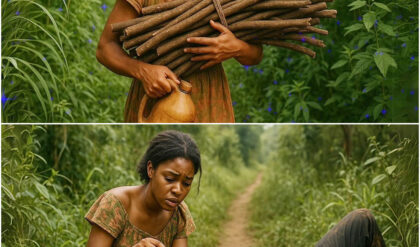
At the underbridgeidge of Lagos that had become a refuge for the forgotten, a young girl, barefoot and dusty, stood frozen on the sidewalk, holding a black nylon bag. Inside it was a steaming plate of jol of rice and a cold bottle of water, her first meal of the day. She hadn’t taken a single bite.
Then she heard a weak voice. Please, I haven’t eaten in 2 days. The voice came from a corner near the foot of a broken street light. It was rough and dry like sandpaper. She turned and saw him a blind beggar. His eyes clouded white, sitting on torn cardboard, shaking slightly from hunger. Ella’s lips trembled. The food was meant for her and her mother.
Her mother who hadn’t eaten since yesterday. Her mother who told her just that morning, “If you see someone in worse pain than you, give what you can, even if it’s all you have.” And now,” her mother’s voice echoed louder than the rumbling in her belly. She bent down. “Uncle, here, eat this, please.” The man’s hands found the bag and tore into the nylon. Within seconds, the jaw of rice was gone.
He drank the water in one long gulp, then wiped his mouth with the back of his hand. Then, he did something unexpected. He smiled, turned in her direction, and whispered, “Thank you, young lady. You don’t know what you’ve just done? Ella blinked. What did he mean? Can you take me to your mother? He asked calmly, wiping his palms against his faded trousers. She hesitated, then nodded slowly.
Earlier that day. Before this moment, Ella’s day had begun like all the others in struggle. She awoke curled beside her mother on a flattened carton under the bridge. Her stomach already groaning with emptiness. Their tiny bag of clothes was clutched tightly in her mother’s arms.
The only belongings they had left since the fire consumed their roadside provision shop two months ago. That fire was never explained. One day they had a life and the next they were under the bridge. Helen, a woman of great dignity, despite her torn wrapper and worn slippers, had never stopped believing in kindness. She raised Ella on principles, even in poverty.
Don’t ever curse this life,” she would say, tightening the scarf on her head. “We’re alive. And while we breathe, we fight with love.” It was a strange thing to speak of love while sleeping beside sewage and shivering through the night. But Ella believed her. At 10 years old, Ella had stopped going to school. Her books were ashes, and her classroom had become the streets. She spent most days begging.
Not aggressively, she had manners. Helen taught her to smile and say, “Good afternoon, Ma. Please help me eat.” That day, she stood near a popular roadside bouer, watching customers walk in and out. Her eyes darted between plates of rice and the money exchanging hands. A middle-aged woman in a blue anara gown noticed her. “Are you hungry?” she asked. Ella nodded shily.
“Wait here.” The woman disappeared and returned with a hot plate of jol of rice and a cold bottle of water. Here, eat and be safe, she said, handing it to Ella. Thank you, Ma. Ella beamed, tears pricking her eyes.
Clutching the food like treasure, she turned and began the walk back to the underbridgeidge to share it with her mother. Then came the blind man, and everything changed. “Why do you want to see my mother?” Ella asked as they walked slowly through the narrow pathway behind a mechanic shop. She supported the man’s elbow gently, helping him avoid potholes. I just want to meet the woman who raised you, he said, his voice oddly calm.
People like you don’t just happen. You’re taught. When they reached the abandoned house with the leaking zinc roof, Helen was seated on a wooden stool, mending Ella’s only gown with a needle and thread. She looked up as they approached. Ella, who is this man? He was hungry. Mama, I gave him the food.
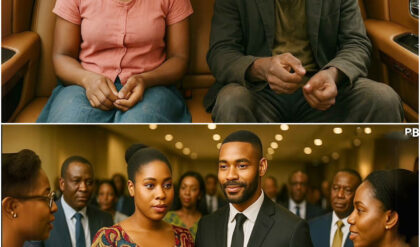
Helen’s eyes widened, then filled with pride, not anger. She stood up slowly and offered the man her stool. “You must be tired. Please sit,” she said softly. “Thank you,” the man replied, lowering himself down. He turned his head slightly toward her. “You raised her.” “Well, “She’s all I have,” Helen whispered. There was a long silence.
Then the man reached into his back pocket and brought out something strange, a small folded card. He handed it to Ella. Read this. Ella unfolded it. It was a business card. She squinted. Mr. Jonathan Adabio, CEO, Adabio Holdings. She blinked. Her heart skipped. Helen reached over, took the card, and gasped. “No, this can’t be real,” she muttered.
Adabio Holdings, the billionaire company. Mr. Jonathan smiled faintly. I lost my sight 5 years ago in an accident. But I didn’t lose my purpose. Since then, I go out from time to time disguised as a beggar, not because I need food, but to find hearts like yours. People who still give when they have nothing. Ella’s jaw dropped. Helen’s knees gave way.
And she dropped to the floor. No, no. This is a dream, she whispered. It’s not. And today, I found who I’ve been looking for. He stood slowly, reaching for his phone in his pocket. I’ll send my driver now. I want you both to come with me. To where? Ella asked, still trembling. He smiled. Home.
As they waited beside the broken gate, a sleek black SUV pulled up, its tinted windows rolling down to reveal a uniformed chauffeur. The moment Helen and Ella stepped into the car, Mr. Jonathan made a call. Yes, tell the staff to prepare the guest wing and please call the principal of Grace International School. We have a special student to register tomorrow. Ella looked up from her seat, eyes wide. Me? Mr. Jonathan nodded, smiling gently.
It’s time your dreams started. But just as the car pulled into the main road, a black van slowly began following them from a distance unnoticed. As the black SUV weaved through the busy streets of Lagos, Ella sat quietly beside Mr. Jonathan. The CEO turned blind beggar, who had just turned her world upside down.
Her fingers were clenched tightly around her mother’s hand, as if letting go would wake her from a dream. Everything felt unreal. the cold air of the car’s AC, the soft seats, the scent of expensive leather, and the surreal truth about the man seated just beside her. Helen, too, sat in stunned silence, her lips moving in prayer. Her eyes were fixed on the road, though her thoughts were racing elsewhere.
Could this really be happening? But behind them, the black van kept its slow, steady pace, always just out of sight. The SUV pulled up in front of a massive estate in Ecoy. Towering white gates slowly swung open to reveal a mansion that looked like something out of a movie. Polished marble pillars, manicured gardens, and a driveway lit with warm golden lights stretched as far as Ella could see. “Welcome to your new home,” Mr.
Jonathan said as the chauffeur stepped out and opened their door. Ella couldn’t move. Her legs felt like jelly. She glanced at her mother, whose eyes had welled up with silent tears. “I haven’t walked through a gate in months.” Helen whispered. A young woman in a tailored suit approached them with a bright smile. “Good evening, sir. I’m Claraara, the household manager.
Everything is ready.” Mr. Jonathan turned toward Ella. Claraara will show you your rooms. Freshen up. Dinner will be served in 30 minutes. I’ll join you shortly. Ella nodded, still speechless. Their new bedroom was nothing like the leaking abandoned house they had been calling home.
Creamcoled walls, soft velvet curtains, a sparkling chandelier, and a bed big enough to fit four people. Ella tiptoed into the bathroom, and when she saw the gleaming bathtub and fluffy towels, she gasped. “Mama, is this really for us?” Helen wrapped her in a hug. It is, my child, I don’t know how, but it is. Just then, there was a knock on the door. Claraara stepped in with two shopping bags.
“Miss Ella, I brought something special for you. Inside were new clothes, shoes, and a shiny backpack. You’re starting school tomorrow,” Claraara said. “Grace International, full scholarship. The principal already confirmed your admission.” Ella’s hands trembled as she picked up the backpack. “I’m going back to school.” Claraara smiled.
You’re not just going back, you’re going to thrive. Later that night, after dinner, a threecourse meal served in a glass dining room overlooking a lit garden. Mr. Jonathan invited them to sit with him in the lounge. The room smelled of aged wood and cologne. Paintings lined the walls, trophies from humanitarian work, charity awards, and certificates framed in gold hung proudly on one side. I wasn’t always like this,” Mr.
Jonathan said, sitting on a velvet couch, cane resting beside him. “I was once a cold businessman, focused on profit and power. But 5 years ago, a fire just like the one that took your shop changed my life. Helen’s eyes widened. My wife and daughter died in it. I survived, but I lost my sight. I lost everything that made life worth it.
Ella’s hand crept into her mother’s, squeezing tightly. I went into hiding not because I was afraid but because I needed to understand suffering. I needed to find people who hadn’t lost their humanity despite having nothing. He turned his blind eyes toward Ella. And today I found that person. There was silence. Then he turned to Helen. Ma, you did something powerful.
You raised a child who still gives even when she has nothing. That kind of heart can change the world. Helen choked on a sob. I want to help you both rebuild, not as charity, but because the world needs more Ella’s. The following day, Ella wore her new uniform with pride. She couldn’t stop twirling in front of the mirror.
Her hair had been braided neatly. Her shoes clicked proudly on the marble floor as she walked with Claraara to the waiting car. Helen watched with tearary eyes, standing beside Mr. Jonathan, who leaned on his cane. You’ve given me back my child’s future,” she said quietly. “I only uncovered it,” he replied.
But just as the gates opened to let the school car out, the same black van from the night before crept to a stop two streets away. A man in a faded jacket lit a cigarette and picked up a phone. “She’s here,” he said. The girl and the mother, and the old man’s blind as a bat. A voice on the other end of the line responded, “Good.
Keep eyes on them. Don’t act yet. We’ll take them when the time is right. Ella’s first day at grade international school was like walking into a new world. The classrooms had air conditioning. The walls were decorated with paintings and inspirational quotes. Students wore clean uniforms and spoke with big dreams in their eyes. But Ella was determined not to feel small.
When her teacher asked, “What do you want to be when you grow up?” She stood up and said proudly, “A medical doctor.” So I can help sick people like my mama helped me. There was a moment of silence. Then the class erupted in claps, but someone was watching even here. A janitor who wasn’t really a janitor. He watched Ella from a distance, a small earpiece hidden beneath his cap. She’s fitting in quickly, he muttered.
Better move faster. Mr. Jonathan sat with Claraara and his lawyer later that evening. I want Helen to have ownership of one of our mini marts, he said. Set it up for her with full staff. Let her manage it if she wants or just earn from it. And prepare a trust for Ella’s education up to medical school. Claraara nodded, her eyes shining.
Sir, this will change their lives forever. It already has, he whispered. But just as he stood to return to his room, his cane bumped into a small camera that wasn’t there before. He picked it up, frowning. Claraara, get me security. Now, as night fell and Ella lay asleep in her new room, dreaming of white coats and stethoscopes, a shadowy figure scaled the outer fence of the estate.
Silently, swiftly, in the back room, Claraara gasped as security played the CCTV footage backward. “There’s a breach,” the guard said. And the last frame, a masked figure standing at the back door, holding a syringe. The mansion was wrapped in an eerie silence. Outside, the trees swayed softly in the night wind.
But inside the estate, alarm bells were quietly ringing only, not the kind that made noise. Inside the security room, Claraara leaned over the monitor, her hands trembling slightly. The masked figure in the last frame was still paused on the screen, the syringe in hand glowing faintly under the night camera’s infrared.
“Who is this?” she demanded, her voice sharp. “We don’t know yet,” the chief guard replied. “No one’s broken into the estate in over 5 years. But whoever this is, they knew where to enter. The back gate’s motion sensors were disabled manually.” Claraara’s stomach twisted. She picked up her phone and dialed Mr. Jonathan’s emergency number.
Meanwhile, in her room, Ella turned in her sleep, unaware of the danger, just a few meters from her window. Her dreams were peaceful. She was wearing a white doctor’s coat, walking through a hospital hallway, children smiled at her. Her mother stood behind her, clapping. Then, suddenly, the dream shifted. The walls went dark. Her mother disappeared.
A faceless man in a mask stepped forward. Ella jolted awake. She looked around the dark room, breathing heavily. And then there was a knock. A single soft knock on the glass window. She froze. Another knock. This time louder. She tiptoed toward the curtain and pulled it aside just an inch, but saw no one. “Ella,” a voice whispered. She gasped.
“It wasn’t her mother. It wasn’t Claraara. It wasn’t anyone she knew. The doororknob to her room started to turn, but before it could open, there was a loud sound. The security alarm blared. Red lights flashed across the hallway. From the estate’s intercom, a calm yet firm voice echoed through every room. Lockdown initiated. All residents remain in your rooms. Mr. Jonathan stood in his hallway, clutching his cane tightly.
Claraara rushed toward him. Sir, we have an intruder inside. They were near Ella’s room. Is she safe? He asked quickly. We believe so. The guards are closing in, but someone on your staff had to help them in. This wasn’t a random break-in. Mr. Jonathan’s lips tightened. It started again, he muttered.
What do you mean? He turned to her, his blind eyes still intense. Someone out there doesn’t want me to help Ella or her mother. Later, as the police arrived and began their search, Ella and her mother were escorted to a secured guest room. Mr. Jonathan joined them soon after, guided gently by Claraara. “I’m so sorry,” he said to them both. “Who would do this?” Helen asked, wrapping her arms tightly around her daughter.
“I’ve made enemies over the years,” he said quietly. “People who don’t like that I give money away, that I help the poor.” He turned slightly toward them. But now I believe this wasn’t just about me. It was about you, about Ella. Helen’s eyes widened. Why would anyone want to harm us? I don’t know yet, but I will find out and I will protect you, no matter the cost.
The next morning, a security officer found something strange in the estate garden. A pendant, old, rusted, but clearly expensive. On its back was a name carved in small cursive letters. I amide. When Claraara showed it to Mr. Jonathan, his face stiffened. I know this name. He sat down slowly. I omay was once a staff member here years ago.
A brilliant young man. I sponsored his education just like Ellis. What happened to him? Claraara asked. He disappeared one night, stole millions from our charity fund and vanished. But why would he come back now? Claraara asked. Maybe he never left. Despite the chaos, Mr. Jonathan insisted Ella attends school.
We can’t let fear take your dreams away, he told her. She nodded bravely and got into the school car. This time with two security escorts following behind. Her day started well. She made two new friends, Simei and Joshua, who showed her around and made her feel welcome. They laughed together in the cafeteria and for the first time in months, Ella felt like a child again until she found the note.
It was slipped into her locker. Stay away from the old man or the next time your mother won’t wake up. She froze, hands trembling. She rushed to the teacher and gave her the note. The principal was called. Claraara was notified. By afternoon, Ella was pulled from school and rushed home under full guard. Mr.
Jonathan met her at the door. “They’re watching us closely,” he said. “This is no longer just about kindness. This is a war against hope.” That night, as tension thickened in the mansion, Mr. Jonathan called Helen to his private study.
“I need to ask, is there anything in your past we should know about?” Helen hesitated. Then she nodded. Years ago, before I met Ella’s father, I worked as a secretary in a company that was involved in shady dealings. When I found out and tried to report it, I was framed and fired. One of the men behind it was named. She paused, trembling. I am eyed. Mr. Jonathan’s cane dropped from his hand.
Helen, that’s the same man. Just then, an urgent knock came to the door. A guard burst in. Sir, Ma. Someone broke into the school. Ella’s name was scratched onto the chalkboard with red paint. What? Sir, that’s not all. They left a message. He handed Claraara a picture. On it was a photo of Ella in school that day, surrounded by two smiling friends. But one of them, Joshua, had been circled in red marker.
And behind the circle, someone had written in dripping ink. She will give everything. Just like before, the mansion was no longer a place of peace. It had become a fortress. Security cameras buzzed. Dogs barked. Every exit and entry point was now manned by uniformed guards.
Inside, Helen sat quietly in the corner of the living room, her arms wrapped tightly around Ella, who trembled despite the warm throw blanket around her. She will give everything. Just like before, that message haunted them both. And worse, Joshua, the cheerful, kind boy Ella had just met, was the one circled. But why? Mr. Jonathan sat silently in his armchair, his fingers steepled beneath his chin.
Though blind, his instincts were sharper than most men with sight. His mind was racing. “I don’t believe in coincidences,” he said finally. “If I amide is behind this, then someone inside is working with him. Someone very close.” Claraara walked into the room holding her tablet. “Sir, we’ve reviewed the school’s security footage.
Play it,” Mr. Jonathan said firmly. She turned the screen toward him, even though he couldn’t see. Ella leaned in. What she saw made her stomach drop. It was footage from earlier that day. Joshua walking into the school before the bell rang. But he wasn’t alone. A tall man in a hoodie handed him a small envelope.
They spoke for barely a second. Joshua nodded, tucked the envelope in his bag, and went inside. Helen covered her mouth. He’s working with them. Ella’s voice cracked. Not necessarily, Claraara replied. He might have been threatened or manipulated. We don’t know yet. But we will, Mr.
Jonathan said, rising slowly with his cane. Claraara, prepare a car. I want to meet this boy’s parents. They arrived at Joshua’s neighborhood, run-down section of mainland Lagos, where street lights barely worked and electricity blinked like candle flames. When they knocked on the wooden door of his house, a woman answered, her eyes sunken, her shoulders weary. Good evening.
Claraara began gently. We’re here to talk about your son, Joshua. The woman hesitated, then stepped aside. Please come in. Their small room was cluttered with buckets, clothes, and a tiny kerosene stove in the corner. Joshua sat on a stool, head bowed. When he saw Ella, his face pald.
I didn’t know, he said before anyone spoke. I didn’t know they would hurt you. Then why? Ella whispered. He looked at her with tears in his eyes. They told me they’d pay for my mother’s surgery. She’s dying. We have no money. They said if I gave you that note and passed your schedule to them, they’d help us. I didn’t want to.
But Ella’s heart softened, but her fear did not. Who gave you the message? Mr. Jonathan asked gently. Joshua hesitated. Then he pulled something from his Pqueta business card. Burnt around the edges. Claraara’s face drained of color. That’s one of the shell companies I omiday used years ago. It was shut down. At least we thought.
Mr. Jonathan stood still, his face a mask of quiet fury. Claraara, prepare the car. We’re paying a visit. They tracked the address on the card to an old warehouse near the Apapa port. It looked abandoned, cracked windows, rusted gates, weeds swallowing the driveway. But when they got close, the guard dogs barked. “This isn’t just storage,” Mr. Jonathan said. “It’s a base.
” Security surrounded the warehouse. Inside, rows of computers buzzed softly. fake documents, identity cards, accounts, charity scams. And at the far end, I admire a tall man in a suit without a tie, smirking behind a desk. “Well, well,” he said, standing slowly. The blind billionaire finally found me. Mr.
Jonathan’s grip on his cane tightened. “Why are you targeting Helen and her daughter? I am chuckled. Oh, come now, John. You of all people should know the answer because she tried to destroy me and now I’ll destroy her hope. She didn’t destroy you. Jonathan replied, voice low. You destroyed yourself.
You stole from people who trusted you. You ran from your shame. And now I’m going to expose you, Claraara said, stepping forward with her phone recording. But I am only smiled wider. You think this ends with a video? I’ve already planted what I needed. And when I press this, he lifted a small remote. Your precious Ella becomes history. Claraara lunged forward, grabbing the remote, wrestling it from his hand just in time. Guards rushed in.
Imamide was pinned to the floor, shouting threats no one listened to anymore. As the police handcuffed him and dragged him away, Mr. Jonathan turned toward the window. “She must never know how close she came to dying,” he said quietly. Claraara nodded. I’ll make sure of it. Back home, Ella was waiting at the gate when the car pulled in. She ran into her mother’s arms as Mr.
Jonathan stepped out, tired but smiling. Everything is going to be okay now, he said gently. Ella looked up at him. “Is it over?” “Almost.” He knelt slightly, his hands resting on her shoulders. “You’ve been through more than most children your age, and yet you still chose kindness. That’s what makes you different. That’s what makes you powerful.
She nodded, her eyes glistening, and it’s time the world saw that power. He turned to Claraara. Let’s begin her foundation. That night, under the soft light of the moon, a press conference was held in the garden of Mr. Jonathan’s estate. News reporters lined the hedges. Cameras flashed, microphones extended. Mr. Jonathan, wearing his signature black suit and sunglasses, stood beside Ella and Helen.
I present to you, he announced, the Ella Foundation, dedicated to helping homeless children get access to food, shelter, and education. Inspired by a little girl who gave her last meal to someone in greater need. Applause echoed. But far away, in a dark cell, I am sat on a bench, whispering to a guard. “They think it’s over,” he hissed.
“But they haven’t met the real people I work for.” The sun rose over Lagos like a promise. Golden rays cutting through the morning haze and resting gently on the mansion’s rooftop. Birds chirped over marble balconies and polished windows as inside excitement buzzed through the halls. Today was the day. Today, Ella was officially becoming more than just a survivor.
She was becoming a symbol of hope. Downstairs in the dining hall, Helen adjusted Ella’s collar, smoothing out her crisp new shirt. The 10-year-old beamed in her green and white school uniform, the insignia of Grade International Academy now proudly stitched across her chest. “Does it look okay, mama?” she asked, spinning once with giddy excitement.
Helen chuckled softly, eyes damp. “You look like everything I ever prayed for,” Claraara entered with a big smile. Cars ready, but there’s someone who wants to speak with you first. As they turned toward the hallway, Mr. Jonathan appeared, dressed in a traditional Agbada, a calm smile on his face.
Though his eyes were blind, he somehow always looked like he could still see every moment clearly. “I have something to give you,” he said, handing Ella a small velvet box. She opened it slowly and gasped. Inside was a silver necklace with a pendant shaped like a stethoscope for the doctor you are going to become. He said, “Wear it. Remember it.
You’re going to change lives.” Ella threw her arms around him, eyes welling. “Thank you for believing in me.” “I didn’t have to,” he replied, kneeling gently. “You believed in yourself first. When you gave away your last meal at the school gate, the press had gathered again. this time to cover Ella’s official enrollment. Reporters flashed cameras as Claraara gave a brief speech.
“She’s not just a student,” Claraara told the cameras. “She’s a story. Proof that compassion still exists in the world.” Inside the school, Ella was taken to the principal’s office where an unexpected surprise awaited her. A scholarship letter not just for primary or secondary education. Your future is secured,” the principal said kindly.
“Now go make something great of it.” As Ella skipped down the hallway, clutching the letter like treasure, she stopped at the library window. Her reflection stared back at her, “A girl who once begged under bridges, now walking the halls of one of the best schools in Lagos.” She whispered to herself, “I will heal people just like I was healed.
” Meanwhile, back at the estate, Helen received a surprise of her own. Mr. Jonathan stood beside a man in a suit holding a folder. Helen, I’ve officially signed over ownership of one of my neighborhood miniarts to you. It’s yours. Staff, inventory, salary, everything. Helen dropped to her knees. Two don’t even know how to manage a business anymore, she said, shaking.
You won’t be doing it alone, Claraara said. We’ve hired a manager to run the day. Today, you’ll be guided every step of the way. All you need to do is believe in yourself again. Tears poured down her cheeks. Thank you for restoring not just my daughter’s future, but my dignity. Later that week, in a maximum security facility outside Lagos, I amid sat in a visitor’s room, wrists cuffed to the table. But he wasn’t alone.
A man in a white capan entered and sat across from him, face hidden behind dark glasses. He placed a thick envelope on the table. “We warned you not to go after the girl,” the man said coldly. “I didn’t know she was protected like that. You exposed our network. The warehouse was shut down. Our people are fleeing.
” “I can fix it,” I amide begged. “I can get close again. Just let me out.” The man stood, buttoned his coat, and leaned in. You’re done. The plan moves forward without you. And then he walked away, leaving Iomide alone, betrayed by the very system he helped build. 6 years later, the hall at Luth Teaching Hospital was packed with clapping families, proud parents, and glowing graduates in white coats.
Among them stood a young woman, taller now, glowing with confidence. Ella Helen Admmy, top of her class, best in pediatrics and youngest speaker at the ceremony. As she stepped onto the stage to give her speech, she scanned the front row and saw Mr. Jonathan, older now, but still proud. Helen sat beside him, well-dressed and smiling, a successful businesswoman in her own right.
Ella took the microphone. 6 years ago, she began. I was a homeless girl who gave her only meal to a blind beggar. I didn’t do it expecting anything in return. I did it because my mother taught me that no matter how little we have, someone always needs it more. She paused as the room went quiet. That man turned out to be a billionaire. But I wasn’t changed by his money. I was changed by his belief in me.
And today I stand here not just as a doctor but as a living example of what kindness, faith, and second chances can do. Thunderous applause filled the room. Outside, as the graduates posed for photos, Ella walked up to Mr. Jonathan. She wrapped her arms around him. “You gave me tomorrow,” she said softly. He smiled.
“And you gave me a reason to believe again.” They stood there for a moment. Two people brought together by a plate of rice. And as the sun dipped behind the Lagos skyline, Ella turned to the future, her stethoscope glinting in the golden light, ready to change the world, one healed heart at a time.
If you like this story, comment, share, and subscribe to our channel for more interesting stories.