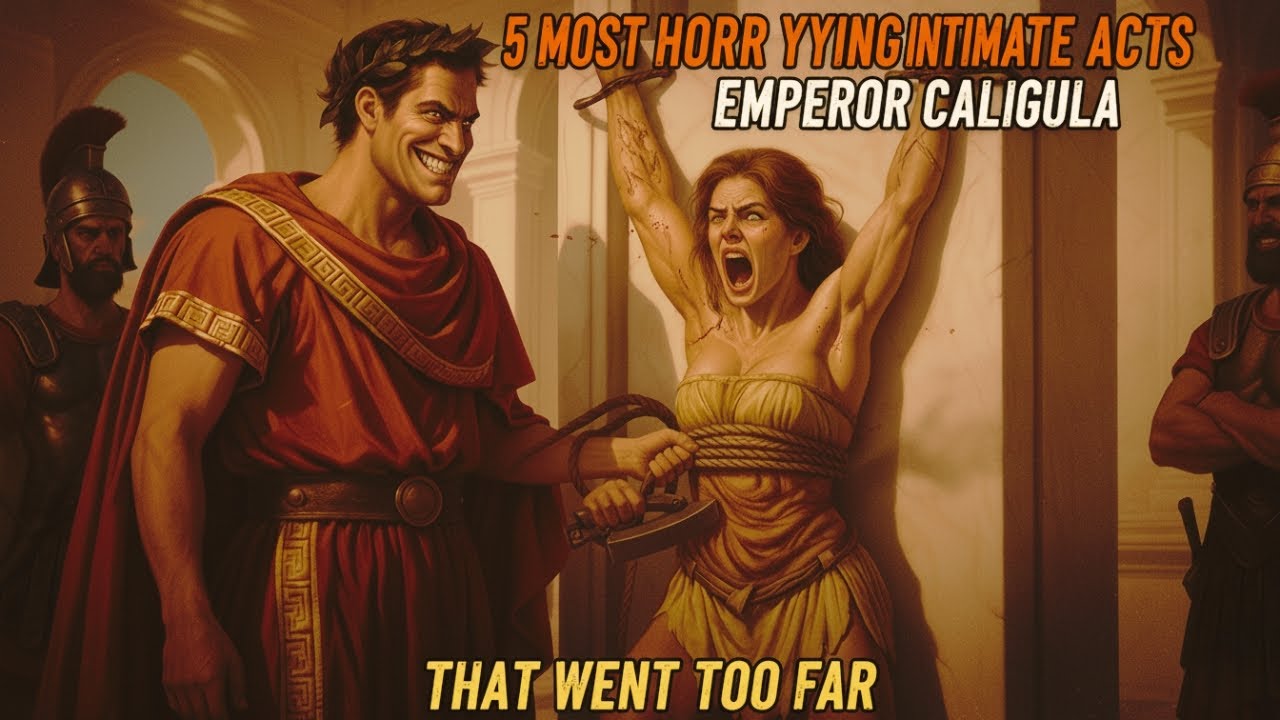
5 Most Horrifying Intimate Acts of Emperor Caligula That Went Too Far
You’re standing in the marble halls of imperial power and the most dangerous man in Rome just asked you a question. Not a real question at test. Your answer doesn’t matter. Your face does. He’s watching the way your eyes move, cataloging the split-second hesitation before you smile. Around you, 50 other men are holding their breath.
Because everyone in this room has learned the same terrible lesson. Survival isn’t about what you say. It’s about what you hide. And the man studying you right now, the one who looks like he’s barely paying attention. The one playing with his wine cup like this is all just entertainment. He’s already decided. You just don’t know what yet.
Before we go deeper into this machinery of terror, drop a comment and let me know where in the world you’re watching from. It absolutely amazes me that a story this dark from 2,000 years ago still reaches every corner of the planet. There’s something about understanding the depths humans can sink to that connects all of us.
His name was Gaes Julius Caesar Augustus Germanicus. History remembers him as Caligula. He ruled Rome for 3 years, 9 months, and 8 days from 37 to 41 AD. In that brief window, he transformed the machinery of imperial power into something the ancient world had never seen. A systematic engine designed not just to kill, but to psychologically annihilate.
The Roman historians Switonius and Tacitus writing within living memory of his reign documented acts so disturbing that scholars still debate whether they’re recording truth or propaganda. But here’s what haunts those pages. The precision, the calculation, the way every act of cruelty served a specific psychological purpose.
This wasn’t madness. It was architecture. and the blueprints were drawn in childhood trauma. Picture a little boy, maybe 7 years old, running through a military encampment along the Ryan frontier. He’s wearing miniature Legionnaire armor, custommade boots that give him his nickname, Caligula, little boots. The soldiers adore him.
His father, Germanicus, is Rome’s most beloved general since Julius Caesar himself. And this child is their living mascot. They believe he brings them luck in battle. They toss him in the air. They teach him camp songs. He falls asleep to the sound of men sharpening swords and telling stories of conquest.
In his world, love and violence are the same thing. Protection and power are inseparable. He has no idea that within a year everything he understands about safety will be systematically destroyed. His father dies first. The official cause, sudden illness. The whispered truth that everyone believes, but no one dares say aloud.
Poison ordered by Emperor Tiberius or someone in his inner circle. Caligula is 8 years old. Then the machine starts consuming his family with methodical efficiency. His mother, Agraina, dragged from their home on charges of treason. His oldest brother arrested and starved in prison until he tried to eat the stuffing from his mattress.
His second brother exiled to an island where guards tortured him until he smashed his own skull against the walls to make it stop. One by one, every person who loved him is erased. By age 19, Caligula is the last surviving male of his bloodline. And then the summons arrive. Emperor Tiberius wants him on Capri, that beautiful island off Italy’s coast that Tiberius has transformed into a fortress of paranoia and depravity.
The ancient sources describe what happened on that island and terms so dark they’re difficult to read even now elderly men inventing new cruelties because traditional ones had become boring. And into this environment walks teenage Caligula who knows with absolute certainty that the man summoning him murdered his entire family.
He cannot show anger, cannot show grief, cannot show anything. Swatonius writes something chilling about this period. There never was a better servant or a worse master. For 6 years, Caligula becomes the perfect student of tyranny. He buries everything human inside himself. He watches. He learns. He becomes exactly what Tiberius wants.
obedient, entertaining, harmless, a living ghost. In 37 AD, Tiberius dies. Some say natural causes. Others say Caligula smothered him with a pillow. Either way, the 19-year-old hostage is suddenly emperor of Rome. The city erupts in celebration. They think they’re getting the son of beloved Germanicus, the little boy in military boots who grew up among heroes.
For seven months, it seems like they were right. Caligula is generous, public-spirited, reforming, and then he gets sick some kind of brain fever that leaves him unconscious for days. When he wakes up, the mask is gone, and Rome is about to discover what 6 years of survival training under a monster has created.
The first act of psychological warfare begins with grief. His sister Dusilla dies the one sister he was rumored to have an incestuous relationship with. Though whether that was truth or political slander, we’ll never know. What matters is thatCaligula takes his personal anguish and weaponizes it against an entire empire. He doesn’t just mourn, he makes mourning mandatory.
Dusilla is declared a goddess by senatorial decree. Temples are built where Romans must worship her. Then comes the legislation that reveals the true horror of what he’s building. It becomes a capital crime to laugh during the morning period. A capital crime to bathe. A capital crime to have dinner with your family. Read that again slowly.
If guards catch you smiling, you can be executed. Imagine that reality. Your child giggles at something. Do you laugh with them? Discipline them? Every moment of natural human joy becomes a potential death sentence. He’s not just enforcing mourning. He’s proving he can criminalize emotion itself, make his inner world everyone else’s mandatory experience.
And once he realizes he can legislate feelings, he starts experimenting with what else he can take. The second act goes after something even more fundamental. Family honor. Ancient sources claim, and historians still argue about this, that Caligula established a brothel inside the imperial palace, not for himself as a business, and it wasn’t staffed by common prostitutes.
The workers were the sons and daughters of Rome’s aristocracy, senators, children, the bloodlines that ruled provinces and commanded armies. He allegedly had heralds announce prices in the forum, different rates for married women versus virgins, special prices for girls from senatorial families. And here’s the detail that transforms cruelty into systematic torture.
He kept ledgers, detailed bureaucratic records, names, dates, transactions, the accounting of human degradation filed away like tax receipts. Think about the psychological precision of this. Roman identity was built on family honor. Your name carried centuries of reputation. [clears throat] And now your daughter’s name is being announced in the streets with a price attached.
And there’s a government document recording it. And you can do absolutely nothing because objecting means watching your entire family die. He’s not just violating their bodies. He’s destroying the one thing Roman nobility valued more than life itself. Their legacy, their name, their place in history. But public humiliation has limits.
You can look away from a forum announcement. You can pretend not to hear the whispers. So Caligula invents something worse. Private humiliation with mandatory witnesses. The third act of his machine. Imperial banquetss become theaters of predation. You’re seated with your wife among dozens of other senators and their spouses. The wine tastes like metal.
Caligula rises and the room falls into silence so complete you can hear tunics rustling. He walks between the tables, evaluating the women with clinical detachment, checking their teeth, their hair, the way you’d inspect livestock. He stops at your table. He takes your wife’s hand. He doesn’t ask, doesn’t acknowledge you exist, just leads her away through the far doorway.
You sit there. The man beside you studies his plate. Everyone pretends this is normal because everyone knows that standing up showing any emotion at all means death for you, her, and your children. 20 minutes pass. 30. The forced conversation around you keeps dying mids sentence. When he finally returns her, she won’t meet your eyes, and then he sits down, stays, and in front of everyone you know, your friends, your rivals, your colleagues, he describes what just happened in detail, clinical, graphic detail, rating her performance,
comparing her to other senators wives, making jokes, and you smile. You laugh at his jokes. You nod like this is perfectly fine, perfectly normal because the alternative is watching your family executed. He’s not just violating your wife. He’s destroying every pillar of Roman masculinity, your authority, your ability to protect your household, your dignity, and tomorrow you have to face these same people, pretend it never happened while everyone knows exactly what happened.
This is the genius of the machine. He’s not destroying individuals. He’s destroying the social fabric itself, making everyone complicit, everyone a witness to everyone else’s degradation. But there’s one bond even stronger than marriage between parent and child. And Caligula realizes that’s where the deepest pain lives.
The fourth act is almost unwatchable. He begins executing people not for crimes but for amusement. Boredom because something about their face annoyed him and he develops a protocol. If he’s executing someone’s son, the father must watch. Front row mandatory attendance. But simple cruelty isn’t enough. Swatonius records a specific incident that reveals the systematic nature of this torture.
A father watches his son killed. That same night, the body still warm, Caligula, has the man brought to the palace for dinner. The father sits at the imperial table, eating food he cannot taste, making conversation he cannot hear,while the man who ordered his son’s death watches him, just watches, studying his face like conducting an experiment, checking for tears, for grief, for any crack in the mask.
Because if the father shows emotion, [clears throat] Caligula will know he hasn’t broken him completely, that there’s still something human left to destroy. So the father smiles, eats, laughs at jets while his son’s body cools somewhere in the city, and the emperor analyzes his facial expressions for entertainment.
He’s not just taking your child. He’s taking your right to grieve. Turning the deepest human bond into a source of terror. Making love itself dangerous because now the more you care about someone, the more vulnerable you are, the more he can hurt you. For 3 years, the machine runs. Senators develop permanent tremors. Families stop speaking at home because walls have ears.
People practice smiling in polished metal so they can get it right when it matters. Rome becomes a city where everyone is performing survival 24 hours a day. And Caligula at the center of this architecture of terror seems untouchable. He has the Ptorian Guard elite soldiers who stand inches from him every day. He has absolute legal authority.
He has proven that fear works better than any law. But the machine has a fatal flaw. While he’s been busy destroying senators, men trained to accept humiliation, who understand politics, who can rationalize their suffering as the price of survival. He makes one crucial mistake. He aims his casual, everyday cruelty at the wrong type of person, a soldier.
His name was Cashas Sharia, senior officer in the Ptorian Guard. These are the men who protect the emperor. Armed, trained, lethal, standing next to Caligula during every banquet, every walk, every private moment. Sharia had one physical characteristic that Caligula found endlessly amusing, a high-pitched voice.
So, every day brought new mockery. And here’s the specific detail that shows how casual his cruelty had become. When it was Sharia’s turn to request the daily military password as standard protocol done in front of other guards, Caligula would assign deliberately affeminate or sexual words. Venus priapus day after day making the other soldiers smirk.
For Caligula, it was throwaway humor barely worth remembering. For Sharia, every joke was another drop of poison. See, Caligula had made a calculation error. Senators could be humiliated because they wanted to live. They had children, estate, legacies worth protecting. But Sharia was a soldier, a man trained for violence, a man who stood next to the emperor every single day with a sword on his hip.
And Caligula had just taught him that life under this emperor wasn’t worth living. He’d become so confident in his system, so certain that fear would always win, that he forgot the most basic rule, never corner something that can kill you. January 24th,41 AD, Caligula is attending theatrical games. He’s in good spirits. Around midday, he leaves through a narrow underground corridor connecting the theater to the palace.
It’s dimly lit, claustrophobic with rough stone walls on both sides. The conspirators are waiting. Sharia steps forward. This is normal. Guards always check in with the emperor. He asks for the day’s password. And Caligula, completely unaware, totally secure in his perceived invincibility, gives one final sneering response.
It’s the last thing he ever says. Sharia screams, “Take this.” and drives his sword up under Caligula’s ribs. The emperor stumbles, tries to run, but there’s nowhere to go. The corridor is too narrow. There are conspirators at both ends. They swarm him. 30 stab wounds according to the sources. 30 times the blade goes in. They don’t stop until there’s nothing left that could possibly be alive.
4 years of accumulated rage, humiliation, and terror released in 60 seconds of frenzied violence. The monster is dead. And that’s when it gets worse. The conspirators find his wife, Quesonia. She’s begging, pleading, trying to reason with men who’ve just killed an emperor. They stab her to death. Then they find the nursery.
Caligula’s daughter, Julia Dusilla, is 2 years old. A soldier picks her up. While she’s crying for her mother, he swings her head first into a marble wall. They have to eliminate the bloodline. Make sure there’s no heir who could grow up seeking vengeance. So they kill a toddler. This is what happens when the machine breaks. It doesn’t just stop.
It devours everything connected to it. For a few hours, it seems like Rome might actually change. The Senate gathers in a tense, uncertain chamber, speaking with a seriousness they haven’t shown in years. They debate whether to restore the old republic or end the imperial system entirely, weighing the possibility of undoing everything that had defined Roman power for almost a century.
For the first time in a generation, there is sincere, vulnerable conversation about what Rome should be. The senators imagine a different future,one where law, tradition, and shared authority, replace the whims of a single ruler. Hope flickers small, fragile, but undeniably there. And then the Ptorian guard makes a decision.
While the Senate argues about political philosophy, soldiers are busy looting the palace. They tear through hallways, ripping tapestries from walls, emptying chests, pocketing valuables. One of them hears something behind a curtain, a faint noise, a tremor of breath. He pulls the fabric aside and discovers a man crouching there, shaking violently, middle-aged, stuttering, limping.
Claudius Caligula’s uncle, the relative everyone dismissed as harmless, awkward, and unthreatening. But the guard doesn’t see a fool. He sees opportunity. He sees the next emperor. The Ptorians seize Claudius, lift him up, and escort him directly to their fortified camp. Within moments, the decision is sealed.
While the Senate is still passionately debating the fate of the republic, Rome’s real power brokers have already acted. The army has spoken, and the machinery of empire keeps turning. The system survives because it wants to survive. That is the real horror. Not that one man was a monster, but that the machine he built continued functioning smoothly without him.
Caligula ruled for less than 4 years, a brief chapter, almost a footnote in the enormous timeline of Roman history. And yet, we still study him 2,000 years later. Why? because he revealed a chilling truth about power. A state’s entire apparatus, its laws, its military, its bureaucracy can be reshaped into instruments of personal psychological warfare.
Caligula didn’t operate outside the system. He weaponized a system itself. The ledgers in the brothel, bureaucracy performing its routine duties, the mandatory public mourning, law enforcement following orders, the elaborate banquetss, imperial hospitality functioning exactly as expected. Every act of cruelty was technically legal because Caligula was the law. His desires were statutes.
His impulses carried the weight of an entire government. When Claudius became emperor, he ordered Caligula’s records destroyed, burned without hesitation. The histories we rely on today were written decades later based on fragments, recollections, and whatever scraps escaped the flames, which means everything we know, the five acts of terror, the calculated humiliations, the systemic brutality is only the portion that survived the purge.
Imagine what was lost. Imagine what was so disturbing that even Rome, an empire that crucified thousands and fed prisoners to beasts, deemed it too horrifying to preserve. 3 years, 9 months, 8 days. In that brief period, Caligula created a blueprint showing every future tyrant how to break human beings, not just physically, but psychologically and methodically.
His machine didn’t disappear. It simply awaited new hands. And ancient sources preserved one final image. In the days after his assassination, when workers swept through the palace, they found a storage room stacked with wooden tablets, not official archives, personal notes, lists of senators and their families, each name accompanied by meticulous observations about fears, weaknesses, desires, and private vulnerabilities.
A catalog of human fragility arranged with bureaucratic precision. They burned those, too. But the knowledge behind them, the idea that vulnerability can be cataloged and weaponized, never burned, it still exists. The machine waits for someone else to remember how it works.