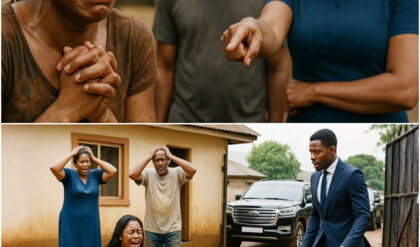
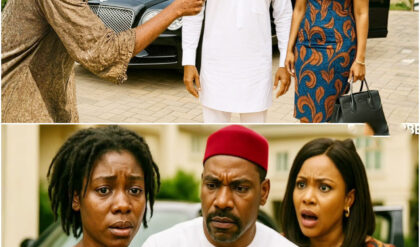
Agnes turned on the TV and froze. There was her wheelchair shining under bright lights at a Lagos auction. The host’s voice boomed. Sold for $1 million. The crowd cheered. Daniel smiled. And Agnes’ heart cracked in a way she could feel in her bones. She did not hear the reporter’s extra words.
She did not see the confetti falling on the stage. She saw only the chair, the smooth handles her fingers knew by heart. the small scratch on the left wheelguard where it once brushed the old mango tree in their compound. The tiny ribbon she tied under the seat the day her husband died. That chair wasn’t just a piece of metal.
It carried her dignity, her memories, and her freedom. The screen flashed Daniel’s name, and a flash of cameras lit his face. He waved like a king. Agnes did not blink. Her throat felt tight. She reached for the remote with shaking hands and turned up the volume as if more sound could make the truth less cruel.
She closed her eyes and for a breath went back in time. Agnes was a 68-year-old widow in a small bungalow in Suruer. Years of illness had slowed her legs until the wheels had to carry what her knees could not. Her late husband, Staff Sergeant Aay, a decorated soldier, bought the wheelchair before he died. He had saved for it, sold his last hunting gun, and said, “My queen must move with pride.

” He died 2 months after, his medals still in a blue tin box in the bedroom. Every time Agnes rolled to the ver to watch the evening sky wash over Lagos, she felt his love holding the handles. But to her only son, Daniel, the wheelchair was nothing but an opportunity. Daniel had always been bright. In school, teachers said he would be great.
Neighbors said he had a star on his head. But when he left home and tasted fast life on Lagos Island, the star grew dim under the harsh light of pride. He found friends who measured a man by the price of his shoes, the sound of his car and the number of bottles on his table. They called him Dan Million. They laughed at his old clothes and his poor mother.
He laughed with them, but the laughter cut him inside. Shame became a fog in his chest. One evening, as Agnes dozed to the soft hum of a generator, Daniel stood by the door of her room and watched her breathe. The night air smelled of fried plantain from a neighbor’s kitchen. The ceiling fan ticked. He told himself a lie he could swallow.
I’ll borrow the chair. I’ll sell it. I’ll bring money. She will be fine. She has neighbors. I will buy her a new one. A better one later. He moved like a shadow. He slipped the ribbon. He lifted the chair with a friend’s help. The metal frame brushed the door and made a small sound. Agnes stirred but did not wake. By morning, the chair was gone.
Daniel was gone too. His phone switched off, his promises silent. For weeks, Agnes waited. She used a wooden stick someone left by the door. She dragged herself to the verander and sat on a stool to catch the sundae. The stool hurt. Her back achd. She learned the full weight of distance. the long corridor to the bathroom, the small step at the kitchen door, the gap between her bed and the window where the light lived.
Neighbors came with food. Mama Titi from the next house washed her clothes and said, “God is in control.” Pastor Jude prayed and said, “A child can lose his way, but not his home.” Agnes smiled gently, thanked them, and kept her pain folded inside like a secret letter. Then came the morning of the auction.
Her TV, Old but Faithful, showed the bright hall on Victoria Island with glass walls and soft carpet and people in suits. The host lifted his voice, hyped the crowd, and pointed to the chair like it was a crown. A new caption slid across the bottom. Special collector’s wheelchair, rare custom celebrity buyers watching. The number on the screen raced up and Agnes felt time run with it.
The camera found Daniel. He looked taller in that light. His watch catching the glow. His smile wide and hungry. Sold for $1 million. The hall exploded. Hands clapped. Someone whistled. Cameras flashed again and again like tiny lightning. Agnes leaned back and held her chest. The pain did not come like a stab.
It came like a long wave, slow and heavy, as if the ocean inside her had decided to rise and swallow everything built on her shore. She remembered the last time Daniel held her hand in public at her husband’s burial. He was 15 then, small and quiet, his eyes read. That boy had promised to care for mama like daddy did.
Where was he now? The news crew interviewed Daniel outside the hall. He laughed and said words that felt like stones. What’s one wheelchair compared to $1 million? She’ll survive. The reporter chuckled. The crowd behind him cheered again. A man slapped Daniel’s back and shouted, “Dan Millian.” The name stuck to the air like smoke. Agnes turned down the volume and looked around her room, the small table with the framed wedding photo of her and Ez.
The tin box of medals, the stool that madeher back cry. A fly tapped the window and tapped again. She took a deep breath and spoke softly to no one but the air. God, is this how my own son will repay me? Her tears came gentle at first, then louder, then loudest, until she had to press the corner of her head, tie to her eyes.
She did not want the neighbors to hear. She did not want pity to stand by her door like a visitor without slippers. She was tired of pity. She wanted justice. She wanted sense to shake Daniel like thunder shakes a roof. She wanted the chair back because it was more than rubber, steel, and screws. It was her promise to herself. I will move. I will not be trapped.
As the afternoon stretched, the neighborhood changed color. The sun slid lower. Children returned from school and played football in the dusty lane. Someone’s radio hummed an old high life tune. A seller balanced a tray of oranges on her head and sang her price. Life went on. But inside the bungalow, time waited for Agnes to make a choice.
She tried calling Daniel. His line was still off. She tried to stand and almost fell. The stick slipped. She reached for the door frame and steadied herself. Anger gave her a kind of power. Not the kind that breaks things, but the kind that builds a straight path in your mind where there was only bush before.
She shuffled to the bedroom. She pulled out the blue tin box. Inside lay the medals wrapped in an old clean cloth. She lifted each one and wiped it with the cloth like she had done for years for bravery, for service, for duty. She looked at the last one, the smallest, the one Es called my heart.
Behind it was a folded paper she had not touched in a long time. Her hands trembled as she opened it. It was the receipt for the wheelchair, the seller’s name, the serial number, the special customization order, a small note in Ez’s handwriting at the bottom. Paid in full for my queen’s freedom. Agnes pressed the note to her chest. The room felt quiet and sharp, as if every object was watching her.
She placed the medals back, closed the box, and took the paper to the table. Then she reached for a notepad, and wrote a list, neat and slow. Hospital report, mobility, dependence, medical need, receipt, serial number, ownership proof, witnesses, neighbors, pastor, seller if alive, auction footage, TV clip, date, statements, lawyer.
She stopped at the last word. She had never hired a lawyer in her life. She did not know where to start, but the thought did not scare her. It steadied her like a firm hand on her shoulder. A knock sounded at the door. Three quick taps, then a pause, then two slow ones. It was Mama Titi’s pattern. “Come in,” Agnes called.
The door opened and Mama Titi peeped in carrying a small cooler. “Rice and stew,” she said. Then saw Agnes’s face and stopped. “What happened? Who called you?” Agnes pointed at the TV. The auction highlight was playing again, the anchor repeating the word record like a prize. Mama Titi put the cooler down, walked closer, and covered her mouth with her palm when she saw Daniel on the screen. God, she whispered.
“Daniel,” Agnes nodded once. For a long moment, they stood side by side. “Two women in a small room, watching a big city celebrate something that tasted like shame in their mouths. “Eat small,” Mama Titi said softly. “You need strength,” Agnes shook her head. “I need sense more than rice.” They both tried to smile. Only one corner of Agnes’ mouth lifted.
Will you tell pastor? Mama Titi asked. Tomorrow, Agnes said. And Daniel. When he is ready to hear, he will call. Until then, I will prepare. She thanked her neighbor, promised to eat later, and waited until the door closed. The house felt different now, like a stage before the curtains rise.
She took the paper and slid it into a clear file. She placed the file on the table and sat back straight, hands calm. Outside, the first stars came out over Lagos. A distant siren wailed, then faded. Agnes reached for the small, old phone she kept for special numbers, the one Daniel did not know about. She scrolled through a short list and stopped on a name she had not dialed in 20 years.
Someone who stood beside her husband on the day he got his last medal and said, “If you ever need me, call.” Her thumb hovered over the green button. She took one more breath and pressed it. The phone rang once, twice. A voice answered firm and familiar. Hello. Agnes swallowed and her voice came out steady. Good evening.
This is Agnes a need help. There was a pause on the line. Tell me everything, the voice said. Agnes looked at the file on the table, at the TV still glowing, at the door that led to the dark lane. Then she began to speak slow, clear, and ready. Daniel became an overnight sensation. The morning after the auction, his picture was splashed across newspapers and blogs.
“Young man strikes gold from nothing to $1 million in a night,” read one headline. Another called him, “The Lagos boy who turned scrap into treasure. He soaked in theglory, smiling for photographers who followed him out of bars and clubs. His phone buzzed with calls from strangers who now wanted to be his business partners. Luxury followed quickly.
He rented a duplex in Leki, filled its driveway with a sleek Mercedes and a Lexus Jeep. He bought gold chains, designer shoes, and the kind of watch that announced its owner before his mouth did. His nights became a blur of loud music, bottles of champagne, and praise from people who would never have known his name if not for his mother’s wheelchair.
But what Daniel didn’t know was that his mother had watched everything silently. Agnes stopped eating. The neighbors noticed her shrinking frame. Mama Titti begged her to take soup, but Agnes would shake her head. Pastor Jude visited, prayed for strength, and whispered, “God will fight for you.” But the wound in her heart was deep.
Each night, she replayed the auction in her head until her pillow was wet with tears. When neighbors confronted Daniel about his betrayal, he laughed with a proud sneer. What’s one wheelchair compared to $1 million? She’ll survive. I’ll get her another. But whispers began to spread. In the market, women shook their heads and asked, “Who sells his disabled mother’s lifeline?” In church, some refused to sit near him.
His new friends joked behind his back. Dan Million turned mama into scrap. Though he pretended not to care, the words gnawed at him like termites in wood. Still, Daniel kept spending. He took his friends to nightclubs on Victoria Island where they shouted his name as if he were a star. He was no longer Daniel, the boy from Suriler.
He was Dan Million, the man who turned wheels into gold. But pride has a way of sharpening its own fall. One night, after a long evening at a club, Daniel stumbled into his Mercedes. Drunk and reckless, his friends cheered as he sped off down the expressway. music blasting. The street lights blurred. The city roared past and his laughter filled the car.
Then came the screech, the spin, the shattering of glass. The crash left his car twisted like foil. The airbags burst. When people pulled him out, blood dripped down his face. He lived, but his right leg was crushed badly. Doctors said he was lucky to survive, but the damage was permanent. Daniel needed a wheelchair. The irony struck him like a hammer.
As he lay in the hospital bed, staring at the white ceiling, he thought of his mother’s chair, the one he sold, the one that had carried her dignity for years. Nurses rolled in a basic hospital wheelchair, but it was nothing like the one he had stolen from her. He had traded her freedom for money, and now, when he needed it most, his freedom was gone.
The parade of friends who had filled his house with noise disappeared like smoke. The men who once clapped his back did not pick his calls. The women who laughed at his jokes left his texts unanswered. Even the reporters who once wrote his name now wrote new stories about other men with other money. No one came except his mother.
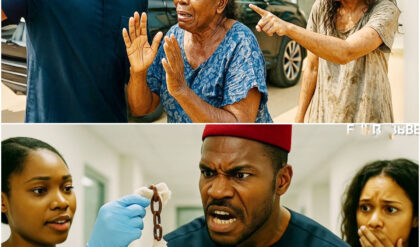
Agnes arrived at the hospital one humid afternoon, leaning on a borrowed stick. Her steps were slow, but her eyes were steady. She entered the ward and stopped by his bed. Daniel<unk>s heart clenched when he saw her. Mama. His voice cracked. He tried to sit, but pain shot up his leg. His eyes fell to the floor.
I didn’t know it would come to this. She said nothing. She only pulled a chair closer and sat quietly watching him. Her silence pressed heavier than words. She placed her hand on his arm and closed her eyes to pray. Her tears soaked the bed sheet. Daniel turned his face to the wall. The shame burned hotter than his pain.
Days passed. Each time Agnes visited, she brought food, prayers, and quiet presents. She asked no questions about the money. She did not scold him. She only sat by his side, as if time itself could mend what betrayal had broken. But deep inside, Agnes had already begun her plan. She had contacted the old soldier’s friend, whose number she still had.
He knew a lawyer who had worked with veterans. Together they began to build her case quietly, one paper, one document, one witness at a time. Daniel thought his mother’s silence meant forgiveness. He thought her kindness meant she had buried the pain, but every step she took into that hospital ward. Every prayer she whispered was building towards something he could not yet see.
The city buzzed outside. Newspapers forgot him. His cars gathered dust. His mansion became quiet. Inside the hospital, Daniel had too much time to think. He remembered the night he lifted the wheelchair out of his mother’s room. He remembered her face on the TV as his name flashed across the screen. He remembered the laughter, the headlines, the champagne, and how quickly it all dried up.
Regret became a stone in his chest. But he said nothing. He believed time would soften her heart. He believed that once he returned home, he would kneel, apologize, and she would forgivehim like mothers always do. But Agnes was not planning forgiveness alone. She was planning payback. Her silence was not surrender. It was strategy.
And when Daniel finally left the hospital, healed enough to limp with crutches. He had no idea that his mother had already set the stage for his downfall. The stage that would shock all of Logos. The day Daniel was discharged from the hospital, the air smelled of rain. He leaned on crutches, his legs stiff inside a heavy brace.
The nurses wheeled him out toward the hospital gate, but when he saw the old taxi waiting, shame tightened around his throat. Gone were the sleek cars, the entourage, the flash of cameras. All that was left was a bruised man limping toward a driver who did not even recognize his name. Agnes stood beside the taxi, her scarf tied neatly, her face calm but unreadable.
She didn’t rush to hug him. She didn’t curse either. She only nodded to the driver and said, “Take us home.” The ride was long, the silence longer. Daniel wanted to speak apologies, balanced on his lips like raindrops waiting to fall, but his mother’s quietness held him back. She gazed out the window at the streets of Lagos.
Rushing past, her fingers tapping lightly against her stick. At last, they reached the old bungalow in Suriler. The same place she had lived before the world, called him Dan Million. The compound looked smaller than he remembered. His Lexus was gone, the gate rusty, the paint peeling. He hobbled out of the taxi and felt as though life had rewound the tape, dragging him back to where he started, but weaker than before.
Inside, Agnes had prepared a small room for him. A mattress lay on the floor, a faded blanket folded at the edge. She placed a basin of water beside him and said softly, “Rest.” Then she walked out, leaving him alone with the hollow echo of his choices. Days stretched into weeks. Agnes moved about the house with quiet determination.
She cooked, swept, prayed, and visited neighbors. She greeted him each morning with a nod. Not a smile, not a frown, just a nod. Her silence was like a mirror, forcing Daniel to see himself without distraction. At first, he tried to fill the void. He told her about his pain, his regrets, his plans to change. She listened but gave no answer.
He grew restless. He wanted her to shout, to beat him, to curse him anything, to break the stillness. But Agnes was patient. She let silence do the work that noise could not. Sometimes at night, Daniel overheard her on the phone. Her voice was hushed, steady, unlike the trembling tones he remembered when she begged him not to sell her wheelchair. He caught fragments.
Yes, I have the documents. Yes, the lawyer said next week. Yes, we’ll be ready. Itam in the colossus. He wondered what she was planning, but he did not dare ask. One afternoon, a knock sounded on the gate. Daniel limped outside, curious. A truck stood there, and two men carefully lifted down a large wooden crate.
They carried it into the compound, set it gently in the sitting room, and left without a word. Agnes stood by the crate, her eyes glistening. Slowly, she opened it. Inside lay a wheelchair shining, polished, brand new. Not the old one that had been sold, but something even better. Strong steel frame, cushioned seat, special handles.
Daniel’s heart sank. Mama, I Agnes raised her hand, silencing him. She ran her fingers along the armrest, tears sliding down her cheeks. This, she whispered, was bought with justice, not betrayal. Before Daniel could ask what she meant, a knock came again. This time it was a tall man in a crisp suit carrying a briefcase.
He greeted Agnes warmly and sat down. Madame Agnes, everything is ready. The case will be announced in court next week. We have proof of the fraudulent sale, the veteran’s certificate, and testimonies. Your son’s actions will not remain hidden. Daniel froze. Court: Mama, you’re taking me to court. She turned to him, her voice calm, but heavy with authority.
Daniel, you sold my dignity for money. You thought silence meant weakness. But silence can be a weapon, too. Now the world will hear my side. That night, Daniel could not sleep. He lay staring at the ceiling, his heart pounding. His mother had filed a case against him. If the court ruled against him, his name would be destroyed forever.
He imagined newspapers again, but this time not praising him, but spitting headlines of shame. Greedy son betrays mother. Millionaire turned thief. Is not. His friends would laugh. His enemies would clap. Employers would close doors before he even knocked. He tried to reason with himself. Maybe mama is bluffing. Maybe she just wants to scare me.
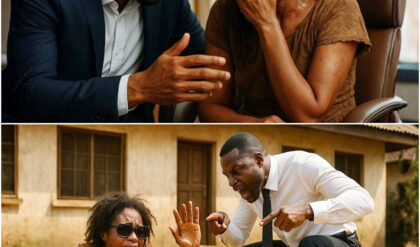
But deep inside, he knew Agnes was serious. Her silence had been no accident. It had been preparation. The next morning, he hobbled to her room. She was sitting by the window, Bible on her lap. “Mama,” he whispered, “I know I hurt you. I was blind, foolish, greedy. Please don’t do this. Give me anotherchance.
She looked at him, her eyes steady, the lines on her face deep like scars of time. Daniel, forgiveness is in my heart, but justice must be in the world. What you did was not just against me. It was against every mother who sacrifices, every widow who suffers, every disabled soul who deserves dignity. My silence was for prayer. My plan is for justice.
Coming, Daniel fell to his knees, his crutches clattering. He wept into her lap, but she did not bend. Her hand rested on his head, not in comfort, but in strength. If God wills, you will rise again. But first, you must face the truth. By the weekend, the story had already begun to spread. A popular blogger hinted at it.
Auction scandal, greed, and betrayal in Lagos. Neighbors whispered louder. Some pied Daniel. Others said he deserved it. The pastor spoke about betrayal on Sunday, and though he mentioned no names, everyone glanced at Daniel sitting at the back, his head bowed. Agnes moved with quiet confidence. She met with lawyers, signed papers, and prepared her testimony.
She no longer walked like a victim. She walked like a soldier’s widow, reclaiming honor. Daniel, meanwhile, drowned in dread. Each step his mother took toward court, felt like a nail in his coffin. He tried calling his old friends, begging for money, advice, support. None answered. He was alone. At night, he dreamt of his mother’s face on the witness stand, telling the world how he betrayed her.
He dreamt of the judge slamming the gavl. He dreamt of reporters chasing him, microphones thrust in his face, asking, “Why did you sell her wheelchair?” He woke in sweat, gasping. The morning of the hearing arrived. The sun rose bright over Lagos, the city buzzing with the noise of buses and traders.
Agnes dressed in her best anchor, her head tie neat, her eyes firm. She looked like a queen preparing for battle. Daniel sat in the corner, trembling. He wanted to run, to vanish, to undo time. But there was no escape. As they stepped out of the house, a crowd had already gathered at the gate. Neighbors, journalists, strangers holding phones.
Cameras clicked, questions flew. Madame Agnes, is it true your son betrayed you? Daniel, did you really sell your mother’s wheelchair for $1 million? Will you face prison? Daniel’s chest tightened. His mother did not answer. She simply walked forward, her silence heavier than their noise. And Daniel realized with horror.
His greatest fear was not the court. His greatest fear was that his mother’s silence might break not into forgiveness, but into a truth so loud it would shatter his life forever. The courtroom in EA was buzzing even before the judge arrived. Reporters packed into the benches, their pens poised, cameras flashing.
Vendors outside sold newspapers with headlines like wheelchair auction, scandal rocks, Legos, and Sunfac’s mother in court. Daniel sat in the dock, his crutches leaning beside him. His once proud shoulders were slumped, his face pale. The weight of the crowd’s eyes pressed down like a mountain. The world that once cheered Dan Million now looked at him as though he were a criminal.
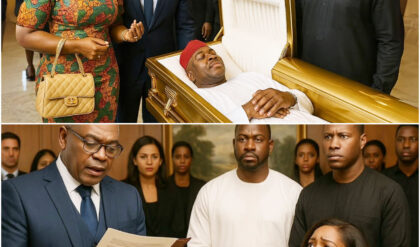
Agnes entered quietly, supported by her stick, dressed in a crisp blue anchor. Her head tie was tied high, her dignity restored. As she moved to the witness stand, murmurss rose in the room. That’s her. That’s the mother. She did not look at Daniel. She kept her gaze fixed forward as steady as a soldier on parade.
The judge, a stern man with glasses perched low on his nose, struck the gavvel. Court in session. Silence swept the hall. The prosecutor, a lean man in a dark suit, stepped forward. My lord, this case is simple. A son, entrusted with the care of his widowed, disabled mother, chose greed over love. He stole her lifeline, a wheelchair that was not only a gift from her late husband’s comrades, but also a symbol of her dignity, and sold it at an auction for $1 million.
Today, we will prove that his betrayal was not only moral, but criminal, and we will seek justice for Madame Agnes. Daniel’s lawyer rose quickly. A younger man, nervous, but trying to appear confident. My lord, my client admits to selling the wheelchair, but he had no criminal intent. He believed he was securing wealth for himself and his mother. Foolish, yes.
Greedy, perhaps, but criminal? No. We ask this honorable court to consider that at the heart of this matter is a family dispute, not a crime. And self. The judge adjusted his glasses. Proceed. When Agnes took the stand, the room leaned in. Her voice was soft, but it carried across the hall. My husband was a soldier, she began.
He fought for this country. Before he died, his comrades gave me that wheelchair so I would not be stranded in my disability. That chair was more than metal and wheels. It was my freedom, my companion, my husband’s last gift to me. Her eyes glistened as she continued. My son Daniel knew this. He saw how I cherished it.
Yet one night, without my consent, he carried it out of my room and sold it for money.When I saw it on television being auctioned, I felt my heart break, not because of the chair alone, but because my own blood had chosen gold over me. The courtroom was silent. Even the reporters stopped scribbling for a moment. The prosecutor leaned closer.
“Madame Agnes, what do you seek from this court?” She lifted her head, her voice steady. “Justice, not just for me, but for every mother who sacrifices and is repaid with betrayal. Let the world know that a mother’s dignity is not for sale. When Daniel was called to the stand, he limped forward, his head bowed.
His lawyer whispered urgently, “Speak with remorse.” Daniel cleared his throat, his voice trembling. “My Lord, I did it. I sold the wheelchair.” At the time, I thought money would solve everything. I thought I could buy her another, a better one. I was blind, foolish. I didn’t realize I was tearing her heart apart. He glanced at his mother for the first time.
She did not return his gaze. Since the accident, I understand what I took from her. I know now what it means to depend on a chair for dignity. I regret it deeply. Mama, I’m sorry. Some in the gallery murmured. A few even sighed in pity, but Agnes remained unmoved. The prosecutor struck quickly.
Daniel, is it true you spent the money on cars, parties, and luxury items? Daniel’s face flushed. Yes. Is it true you mocked neighbors who questioned you, saying, “What’s one wheelchair compared to a million dollars?” Daniel swallowed hard. “Yes,” the prosecutor’s voice rang out. “So you admit this was not for her well-being.
It was for your vanity, for greed.” Daniel’s silence was answer enough. As testimonies continued, more witnesses stepped forward. Neighbors recounted how Agnes had wept. The night of the auction, a pastor spoke of counseling her through her sorrow. Even the auction house manager testified that Daniel had concealed the chair’s sentimental value, presenting it only as a rare collector’s piece.
The judge listened intently, his face unreadable. At one point, Daniel’s lawyer tried to shift blame. My lord, if the auction house accepted it, should they not bear some responsibility? But the judge cut him short. council. The moral weight of this matter lies squarely on the accused. Do not distract this court.
The gallery erupted in murmurss again. Just when it seemed the case was closing, Agnes’ lawyer brought out a surprise. Documents showing that the proceeds of the auction had already been frozen by court order. Gasps filled the hall. The lawyer explained, “My lord, Madame Agnes filed this case not only for justice, but to ensure the money is recovered.
We request that the funds be redirected toward a foundation for widows and disabled mothers as per her wish. All eyes turned to Agnes. She nodded gently. Let my pain become healing for others. If my son will not honor me, then let strangers benefit from what he stole. Daniel’s mouth dropped open. He hadn’t expected this.
He thought his mother only wanted to shame him. But now she was about to strip away the last remnants of his pride, the money itself. The judge looked over his glasses at Daniel. Do you have anything to say? Daniel’s lips trembled, but no words came. The judge banged the gavl. This court will reconvene tomorrow for final judgment. The truth has been heard.
Justice will be delivered. The crowd spilled out of the courtroom, buzzing with excitement. Reporters shouted questions. Cameras flashed. Headlines were already forming. Agnes versus Daniel. Judgement day awaits. Inside the emptying hall, Daniel sat alone in the dock, staring at his mother. She rose slowly, her stick tapping the floor.
For a brief moment, her eyes met his calm, steady, unbroken. Daniel realized with a chill that tomorrow might not only decide his fate, but also rewrite his name forever. And as the court adjourned, Lagos waited with baited breath for the verdict that would shock everyone. The next morning dawned heavy over Lagos.
The sky was swollen with clouds as though heaven itself was waiting for the judgment. By 8:00 a.m., the courthouse was already surrounded. Vendors shouted, selling puffpuff and newspapers. Reporters jostled for space. The headline on almost every front page screamed, “Mother versus son justice or mercy.
” Inside the courtroom, the air was thicker than the heat outside. Cameras clicked, pens scratched. People leaned forward as if the seats could not hold them. Everyone wanted to see how this would end. Daniel sat in the dock, his hands trembling around his crutches. He had not slept. His mind replayed his mother’s words again and again.
Justice, not revenge. But what kind of justice would fall today? Prison, ruin, shame forever. Agnes entered quietly. She was dressed in white lace, her head tie tied firmly. Her face was calm like the stillness of deep waters. She did not look at Daniel. She simply walked to her seat, rested her stick against the bench and folded her hands.
The judge arrived and the court rose. The gavl struckonce. This court will now deliver judgment. The judge cleared his throat. We have heard the testimonies. We have seen the documents. The facts are not in dispute. The accused Mr. Daniel sold the wheelchair belonging to his mother, Madame Agnes, without consent. He profited from this sale.
He squandered the money on vanity and he left his mother in pain without dignity. The courtroom was silent, every word heavy. The judge continued, his voice rising. This was not merely a son’s mistake. It was betrayal. Betrayal of trust. Betrayal of family, betrayal of humanity. A wheelchair is not just wood and metal. It is freedom.
To take that from a disabled mother is to wound her soul. Daniel’s throat tightened. Tears stung his eyes, but he forced himself to look at the judge. The judge’s tone softened slightly. However, we also note that the accused has confessed, has shown remorse, and himself now lives in disability after his accident. This court believes punishment must teach, not only destroy.
Therefore, the gavl struck. This court orders that the $1 million obtained from the auction be permanently transferred into a foundation established in the name of Madame Agnes for the support of widows and disabled mothers. Furthermore, the accused Daniel is sentenced to community service at the foundation for a period of 2 years under supervision.
Let him serve those he betrayed. The courtroom erupted. Some gasped, some clapped, some shook their heads. Reporters dashed for the exit to file the news. Cameras flashed like lightning. Daniel’s collapse. Daniel sank to his knees, his crutches falling. Tears flowed freely down his cheeks. Prison had been his fear. But this was worse.
To serve at the very foundation that bore his mother’s name. To live daily in the shadow of her dignity was a sentence heavier than bars. He looked at Agnes, desperate for even a flicker of mercy. Mama. His voice broke. I’m sorry. Please forgive me. Agnes rose slowly, her stick tapping against the floor. The court fell silent again, waiting for her response.
She walked toward him, every step echoing. When she stood before him, she looked down with steady eyes. “Daniel,” she said softly. “Forgiveness I gave you long ago. But forgiveness does not cancel consequences. You will serve. You will work. You will learn. And perhaps one day you will become the son your father prayed you would be.” Her words cut deeper than any sentence the judge could give.
They were not shouted in anger, but spoken with the weight of truth. Forgiveness was given, but trust would take a lifetime to rebuild. Daniel wept, his tears darkening the marble floor. As Agnes stepped out, reporters swarmed her. “Madame Agnes, do you feel victorious?” one asked. She paused. This is not victory. This is a lesson.
To children, honor your parents. To mothers, never fear to stand for your dignity. To the world, justice may walk slowly, but it always arrives. Her words spread across radio waves and newspapers within hours. By evening, hashtags trended on social media. Austice for Agnes, honor your mother, wheelchair case.
But while the world celebrated her courage, Daniel sat alone in the empty courtroom, broken. He knew his life would never be the same. Weeks passed. The foundation was born, the Agnes Foundation for Widows and Disabled Mothers. The million dollars funded a large rehabilitation center in Lagos.
Rooms were built with modern wheelchairs, physiootherapy equipment, and a training hall where widows could learn tailoring, catering, and crafts to sustain themselves. At the opening ceremony, Agnes sat proudly as the governor cut the ribbon. Cameras flashed, choirs sang, drums rolled, mothers danced with tears in their eyes, praising Agnes for turning her pain into hope.
And Daniel, he was there in plain clothes, sweeping the compound and arranging chairs. The world pointed fingers, some mocking, some pitying. But Agnes never mocked him. She made sure he worked hard, and every day she watched him from afar, hoping that humility would one day replace his pride. One evening, after months of service, Daniel approached his mother as she watered flowers in the compound.
His hands were blistered from labor, his face darker from the Sunday. But his eyes, his eyes were softer than they had ever been. “Mama,” he said quietly. “Today, as I helped a widow into her wheelchair, I finally understood. I saw her smile. I saw her dignity restored. And I realized what I stole from you.
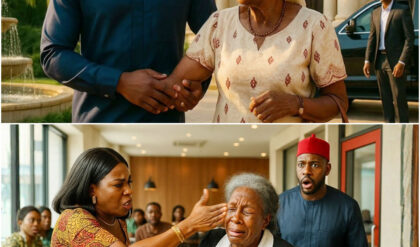
Not money, not a chair, but joy, freedom, dignity. Agnes turned slowly, her eyes misty. Daniel knelt at her feet. I was blind, but now I see. I don’t ask to erase my shame, but I ask for a chance to rebuild, to make you proud. For the first time in months, Agnes touched his shoulder gently. Daniel, I have always prayed for this day. Not for riches, not for fame.
For this moment when your heart would awaken. Tears rolled down both their faces, mingling with the evening rain. The story of Agnes and Daniel became areference. Pastors preached it in churches. Teachers told it in schools. Parents whispered it to their children at night. The lesson was clear. Greed destroys, but truth restores.
Betrayal wounds, but justice heals. Agnes lived to see hundreds of mothers walk again with dignity. Daniel continued his service, slowly rebuilding trust, carrying his scars as reminders. And whenever people passed the foundation gates, they saw the words carved in stone. A mother’s dignity is priceless. Honor her always. But fate was not done.
One evening, as Agnes sat in her chair watching the sunset, a letter arrived. It bore the seal of the very auction house that had once sold her wheelchair. The manager had written, “Madame Agnes, the buyer who purchased your wheelchair, has requested to meet you.” He claims he has something important to return.
“Will you accept?” Agnes’s hands trembled as she read the letter. Daniel stood beside her, confused. “What could he possibly want now?” he asked. Agnes looked at the horizon, her heart beating faster. “Perhaps the story was not over. Perhaps another chapter waited beyond the shadows.
The sun dipped lower, painting the sky in gold as mother and son prepared for a meeting that might uncover secrets they had never imagined. What is your view about this story? Where are you watching from? If you enjoyed this story, comment, share, and subscribe to our channel for more interesting stories.