Sometimes the most powerful women carry the heaviest secrets. When Jimmy Fallon asked Michelle Obama one simple question that Tuesday night, nobody expected her to stop mid-sentence, close her eyes, and whisper the three words that would silence an entire studio. The cameras kept rolling, but this wasn’t television anymore.
This was a former first lady revealing the pain she’d hidden behind her perfect smile for decades. The Tonight Show studio buzzed with its usual pre-show energy. Jimmy Fallon paced backstage running through his notes one final time. Tonight’s guest was Michelle Obama promoting her memoir Becoming, and the audience was electric with anticipation.
Everyone expected inspiration, grace, and those trademark moments of wisdom that had made her America’s most beloved first lady. But nobody, not even Jimmy, knew that within the next hour, Michelle would share something so personal, so raw that it would change how the world saw strength, motherhood, and the courage it takes to be vulnerable in public.
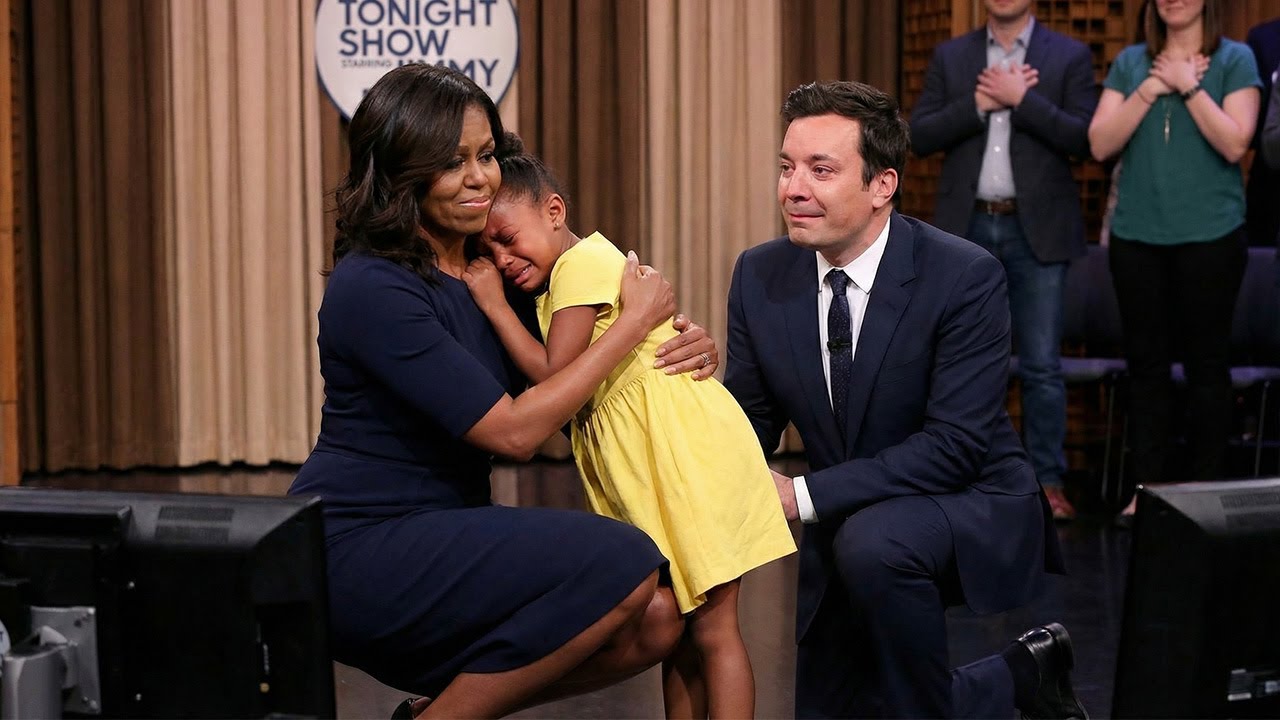
Ladies and gentlemen, please welcome Michelle Obama,” Jimmy announced, his signature grin lighting up the stage. The audience erupted as Michelle walked out, elegant in a navy dress, waving with that familiar warmth that had captivated millions. She looked every bit the confident, composed woman the world knew and loved. They settled into their chairs, Jimmy shuffling his cards with practiced ease.
The interview began smoothly. book talk, family updates, the usual dance of late night television. Michelle spoke about empowerment, about finding her voice, about the journey of writing her memoir. Her answers were polished, thoughtful, exactly what everyone expected. But Jimmy had done his homework. He’d read every page of becoming.
And there was one chapter that had stopped him cold while preparing for this interview. one section where Michelle’s voice had shifted from inspirational to achingly honest. He’d been debating whether to bring it up all week. Michelle, Jimmy said, his voice gentler than usual. There’s something in your book that really struck me, something I think a lot of women watching tonight might need to hear.
He paused, watching her face carefully. You wrote about your struggles to have Malia and Sasha, about IVF, about miscarriage. The change in Michelle was instantaneous. Her practiced smile flickered for just a moment. Her hands, which had been gesturing confidently moments before, stilled in her lap. The studio audience, sensing a shift in energy, grew quieter.
“I did,” she said simply. “But there was something different in her voice now. something unguarded. Jimmy leaned forward slightly. What made you decide to share something so personal? Something that frankly a lot of people still consider private. Michelle took a breath that seemed to come from somewhere deep inside her chest.
She looked out at the audience, then back at Jimmy, and something in her expression changed completely. The former first lady, the lawyer, the public figure, all of that fell away. What remained was simply a woman who had carried pain in silence for too long. Because, she began, her voice barely above a whisper, “I was tired of pretending it didn’t happen.
” The studio fell completely silent. Even the camera operators seemed to sense they were witnessing something unprecedented. “For years,” Michelle continued, her voice growing stronger. I smiled and waved and talked about my beautiful daughters and I was grateful. So grateful for them every single day.
But nobody knew what it took to get there. Nobody knew about the failure I felt in my body. Jimmy set down his cards entirely. This wasn’t an interview anymore. This was a confession, a moment of truth that transcended television. The first time I miscarried, Michelle said, and the word hung in the air like a prayer. I was 20 weeks along.
20 weeks. I had names picked out. I had plans. Her voice cracked slightly. I had hope. The audience was transfixed. Many were crying openly now. This wasn’t the Michelle Obama they thought they knew. This was something raw, something real, something that cut straight to the heart of human experience. But what happened next would stay with everyone in that studio for the rest of their lives.
Jimmy did something he’d never done in 15 years of hosting. He got up from his desk, walked around to Michelle’s chair, and simply stood beside her. Not for the cameras, not for the show, but because sometimes the only response to someone’s courage is to be present for it. I felt broken, Michelle whispered, looking up at Jimmy.
I felt like my body had betrayed me, like I wasn’t woman enough, strong enough, good enough to do this basic thing that women had been doing for thousands of years. The cameras captured every word. But the technicians in the control room were crying too hard to focus properly. This wasn’t entertainment.
This was humanity at its most vulnerable. Barack didn’t understand, she continued, her voice gaining momentum now, as if a dam had burst. He couldn’t understand. He’d hold me while I cried, but I could see in his eyes that he didn’t know how to fix this. and Barack Obama has spent his whole life fixing things. Jimmy knelt down beside her chair, his own eyes wet with tears.
“How did you get through it?” Michelle looked directly into the camera for the first time since she’d started speaking about this. “She almost didn’t,” she said quietly. There were nights when I sat in what would have been the nursery and I wondered if I was being punished for something, if I’d somehow done something wrong. The honesty in her voice was devastating.
Here was a woman who had stood beside presidents who had addressed world leaders who had been a symbol of strength for an entire generation, and she was sharing the moments when she’d felt most powerless. The second miscarriage happened during Barack’s campaign for the Senate. I was supposed to be at a rally that night.
Instead, I was in a hospital room trying to understand why my body kept failing me. She paused, gathering herself. I told Barack to go to the rally. I told him I was fine, that I’d meet him afterward. But I wasn’t fine. I was dying inside and I was doing it alone because I thought that’s what strong women were supposed to do.
Jimmy’s hand found hers, a simple gesture of human connection that transcended every boundary between host and guest, between public figure and private person. “When did you decide to try IVF?” Jimmy asked gently. Michelle’s laugh was bitter and beautiful at the same time. Decide? I don’t think I decided anything.
I was desperate. We were desperate. I was 34 years old and I felt like I was running out of time to become the mother I dreamed of being. She looked out at the audience again and her voice strengthened. But here’s what nobody tells you about IVF. They don’t tell you about the hormones that make you feel like you’re losing your mind.
They don’t tell you about the shots you give yourself every morning, stabbing yourself with hope. They don’t tell you about lying on that table month after month, praying to whoever’s listening that this time will be different. The studio was so quiet you could hear hearts breaking. I remember the morning I got pregnant with Malia,” Michelle said.
And for the first time since she’d started talking about this, she smiled. A real smile, not a public one. I was afraid to believe it. I’d been disappointed so many times that hope felt dangerous. Jimmy was crying openly now, making no attempt to hide it. What was that like? That first moment when you knew it was real. Terrifying. Michelle said without hesitation.
Because I knew I couldn’t survive losing another baby. I knew it would break something in me that couldn’t be fixed. She stood up suddenly, pacing to the front of the stage. The audience watched her move like they were witnessing something sacred. I spent the entire pregnancy with Malia, waiting for something to go wrong, she said.
I was afraid to buy clothes, afraid to paint the nursery, afraid to love her too much before I knew she was safe. She turned back to face Jimmy in the audience. And when she was born, when they put her in my arms and she was perfect and healthy and real, I cried for three days straight.
Not just from joy, but from relief. From grief for all the babies I’d lost. From gratitude that my body had finally, finally done what I’d been begging it to do. The audience erupted in applause, but it wasn’t the usual late night show clapping. It was the sound of recognition, of shared experience, of women and men who had walked similar paths and felt less alone because of what they just heard.
And Sasha? Jimmy asked. Sasha was a gift I didn’t think I deserved, Michelle said, her voice full of wonder. The second IVF cycle worked on the first try. It was like the universe was saying, “Okay, you’ve learned what you needed to learn. Here’s your second miracle.” She sat back down closer to Jimmy now than she’d been all night.
But even then, even with two healthy daughters, I carried the shame of those losses. I carried the fear that I wasn’t enough. Jimmy leaned forward. What changed? What made you decide to share this story? Michelle was quiet for a long moment, considering I was at a library in Chicago reading to kids, and this little girl came up to me afterward.
She was maybe 7 years old, and she said, “Mrs. Obama, my mom is sad because she can’t have a baby. Can you tell her it’s going to be okay? The weight of that moment settled over the studio like a blanket. I looked into this child’s eyes and I realized that by keeping my story secret, I was keeping other women in their pain alone.
I was letting them think they were the only ones failing, the only ones broken, the only ones not strong enough. She stood up again, addressing the camera directly. So, I decided to tell the truth, all of it. The miscarriages, the IVF, the fear, the shame, the guilt, because maybe, just maybe, if I was brave enough to say it out loud, other women wouldn’t have to carry that pain in silence.
The studio audience was on their feet now, applauding through their tears. But Michelle wasn’t finished. I want every woman watching this to know, she said, her voice carrying the authority of someone who had walked through fire and emerged stronger. That your struggles don’t make you weak, they make you human.
Your miscarriages don’t make you a failure. They make you a mother who loved baby she never got to hold. Jimmy was struggling to speak through his emotions. Michelle, what would you say to a woman who’s going through this right now? Without hesitation, Michelle answered, I would tell her that she’s not alone, that her pain is valid, that her grief is real, that her body is not broken, even when it feels like it is.
” She paused, her voice dropping to almost a whisper. And I would tell her that sometimes the most beautiful flowers grow from the deepest soil. That sometimes our greatest gifts come wrapped in our greatest pain. The interview continued for another 20 minutes, but everyone in that studio knew they’d witnessed something transformational.
Michelle Obama hadn’t just shared her story. She had given permission for millions of women to share theirs. As the show ended and the camera stopped rolling, something extraordinary happened. Women in the audience began approaching the stage, sharing their own stories with Michelle. The security guards, instructed to clear the studio quickly, instead found themselves wiping away tears as story after story poured out.
A producer in her 40s shared her eight miscarriages. A young intern talked about her struggles with endometriosis. An audience member spoke about finally getting pregnant at 43 after years of trying. Jimmy watched from the side of the stage as Michelle hugged woman after woman. Each embrace lasting longer than protocol would normally allow.
She wasn’t the former first lady in those moments. She was simply a woman who understood, who had been there, who had survived. Later in her dressing room, Michelle sat quietly, still processing what had happened. Jimmy knocked on her door. “I wanted to thank you,” he said simply. “For trusting us with that, for being brave enough to go there.
” Michelle smiled. And it was different from any smile she’d ever given on television. It was the smile of someone who had just laid down a burden she’d been carrying for 20 years. Do you know what the strangest part is? She said, “I feel lighter. For the first time in decades, I feel like I can breathe all the way.
” The episode aired 3 weeks later and became the most watched Tonight Show episode in the show’s history. But more importantly, it sparked a national conversation about fertility, about loss, about the expectations we place on women to be perfect and strong at all times. Within 48 hours of the broadcast, fertility clinics across the country reported increases in calls from women seeking help.
Support groups for pregnancy loss saw membership surge. The hashtag I am not alone. Started by women sharing their own stories of miscarriage and infertility trended for weeks. Michelle’s revelation didn’t just break her own silence. It shattered a cultural taboo that had kept millions of women suffering in isolation. 3 months after the show aired, Michelle received a letter that would bring her to tears all over again.
It was from the little girl at the library, the one who had asked her to tell her mother it would be okay. “Dear Mrs. Obama,” the letter read in careful second grade handwriting. “My mom watched you on TV and she’s not sad anymore. She said you helped her understand that she’s still a good mom even though the baby didn’t come.
Thank you for making my mom smile again.” Attached was a photo of the little girl with her mother both beaming at the camera. On the back in the mother’s handwriting was a single word, hope. Michelle framed that letter and hung it in her office. A reminder that sometimes the most powerful thing we can do is simply tell our truth. That sometimes our deepest pain when shared becomes someone else’s greatest comfort.
The night of the interview had changed more than just Michelle. It had changed everyone who witnessed it. Jimmy often spoke about it in later interviews, calling it the moment he learned the difference between entertainment and impact. Sometimes, he would say, the best thing you can do as a host is get out of the way and let someone’s truth speak for itself.
And Michelle’s truth, raw, painful, beautiful, and ultimately healing, continued to speak to women around the world because she had been brave enough to say out loud what so many had carried in silence. That loss is part of love, that struggle is part of strength, and that sometimes the most powerful thing we can do is simply refuse to suffer alone.
Her story became more than just a revelation. It became a revolution one conversation at a time, one woman at a time, one moment of shared humanity at a time. Because that’s what happens when someone like Michelle Obama decides to trade her perfect public image for perfect honesty. The world doesn’t just listen, it begins to heal.
But the story doesn’t end there. Six months after the interview aired, Michelle received an unexpected phone call that would prove just how far her words had traveled. Mrs. Obama. The voice on the other end was shaky, uncertain. This is Dr. Sarah Martinez from the Reproductive Health Center in Phoenix. I hope you don’t mind me calling, but I had to reach out.
Michelle had been in her home office working on foundation documents when her assistant transferred the call. Of course, Dr. Martinez. How can I help you? It’s actually how you’ve already helped, Dr. Martinez replied, her voice thick with emotion. Since your interview with Jimmy Fallon aired, our center has seen a 400% increase in women seeking fertility counseling.
But that’s not why I’m calling. Michelle set down her pen, giving the call her full attention. Yesterday, a young woman came to our clinic. She’d been struggling with infertility for 3 years, had suffered four miscarriages, and was convinced she would never be a mother. She was ready to give up entirely. Dr. Martinez paused.
She brought a recording of your interview on her phone. She played it for our entire staff. The doctor’s voice broke slightly. Mrs. Obama, she said that hearing you talk about feeling broken, about feeling like a failure, it was the first time in 3 years that she didn’t feel alone. She said if Michelle Obama could survive this and still become a mother, maybe she could, too.
Michelle felt tears welling up in her eyes. Is she okay? More than okay, Dr. Dr. Martinez said, and she could hear the smile in her voice. We started her on a new treatment protocol yesterday, but more importantly, she left our office with hope. Real hope for the first time in years. After the call ended, Michelle sat in her office thinking about ripple effects, about how one moment of vulnerability could touch lives in ways she’d never imagined.
She thought about all the women who had reached out since the interview, the emails, the letters, the social media messages from mothers and wouldbe mothers around the world. There was the woman in Australia who finally told her husband about her secret miscarriage from 5 years ago. The couple in Sweden who decided to try IVF after years of avoiding it out of fear.
the teenager in Texas who now understood why her mother sometimes cried on certain dates throughout the year. But perhaps the most powerful response had come from an unexpected source. Barack 3 days after the interview aired, her husband had found her in their kitchen reading through some of the thousands of messages that had poured in.
“I never knew,” he had said quietly, sitting down beside her. Michelle looked up from her laptop. Never knew what how alone you felt during those times. How much you blamed yourself. He reached for her hand. I knew you were hurting, but I didn’t understand the depth of it, the shame you carried. They had talked for hours that night, revisiting those painful years with a new understanding.
Barack admitted that he had felt helpless during her miscarriages, that he’d focused on trying to fix the situation instead of simply being present for her pain. “Your interview didn’t just help other women,” he told her. “It helped me understand my wife better, it helped us.” “That conversation led to something neither of them had expected.
” Barack began speaking more openly about the male perspective on fertility struggles, about how partners feel when they can’t take away their loved ones pain. His honesty opened up another layer of dialogue about fertility that had rarely been addressed publicly. The cultural impact continued to grow. Medical schools began incorporating Michelle’s words into their training, helping future doctors understand the emotional complexity of fertility treatments.
Support groups used clips from the interview as conversation starters. Therapists reported that clients were more willing to discuss pregnancy loss after seeing how Michelle had shared her story. But beyond the statistics and the broader cultural changes, there were individual moments that reminded Michelle why she had chosen to speak up.
Like the woman who approached her at a bookstore in Washington, DC, tears streaming down her face, who whispered, “Thank you for making me feel normal.” or the couple who wrote to say they had named their IVF daughter Hope Michelle in honor of the strength they had found in her words. Each story reinforced what Michelle had come to understand about vulnerability, that it’s not weakness, but rather the most courageous form of strength, that when we hide our struggles, we rob others of the chance to feel less alone in theirs. The interview also changed
Jimmy’s approach to hosting. He began incorporating more moments of genuine connection into his show, creating space for guests to share not just their successes, but their struggles. His producers noticed that these segments often became the most watched and most shared parts of any episode. Michelle taught me that entertainment and impact don’t have to be mutually exclusive.
Jimmy would later reflect, “Sometimes the most entertaining thing you can do is just be real with people.” One year after the interview, Michelle returned to the Tonight Show. This time, she brought something special with her, a book of letters from women around the world who had shared their fertility stories after watching her first appearance.
This, she told Jimmy, holding up the thick volume, is what happens when we stop pretending we’re perfect. This is what happens when we choose connection over protection. as she flipped through pages filled with handwriting from dozens of countries in multiple languages, all sharing similar stories of loss, hope, struggle, and eventual healing.
The studio audience fell silent once again. “Every single one of these women thought she was the only one,” Michelle said. “Every single one carried shame that didn’t belong to her. And now because we’re talking about this, none of them has to carry that burden alone. The conversation that had started with three simple words, I was tired, had become a movement.
A movement that reminded the world that behind every perfect image, every success story, every inspiring figure, there is a human being with struggles, fears, and pain. And sometimes the most powerful gift we can give each other is the courage to say, “Me, too. I’ve been there. You’re not alone.” Michelle’s story became a testament to the transformative power of truthtelling, proving that our greatest wounds often become our most powerful tools for healing others.