The director called, “Cut.” The audience started leaving. Steve Harvey waved goodbye and the lights began dimming. The show was over, except one camera operator forgot to turn off his equipment. And what that camera captured in the next 8 minutes would become the most watched behindthe-scenes moment in television history.
Because when Steve Harvey thought nobody was watching, he did something that revealed who he really is. It was February 18th, 2021 at the Family Feud Studios in Atlanta, Georgia. It had been a long day of taping, three episodes backto back, each one requiring Steve’s full energy and attention. By the time the final show wrapped at 6:47 p.m.
, everyone was exhausted and ready to go home. The last episode had been particularly fun. The competing families, the Johnson’s from Michigan and the Washingtons from Georgia, had been hilarious. The Johnson’s had won $20,000, and there had been lots of laughter, surprising answers, and those classic Steve Harvey reactions that made the show so popular.
When the director called cut on the final episode, the standard post show routine kicked into motion. The audience began gathering their belongings. The winning Johnson family took photos with Steve on stage. The production assistant started guiding people toward the exits. The crew began the process of breaking down equipment for the day.
Steve did what he always did. He stayed on stage for a few extra minutes, shaking hands with audience members as they filed out, taking selfies, signing autographs. He was tired, but he never rushed this part. These people had come to see him, had waited hours for this experience, and he made sure every single person who wanted a moment with him got one.
After about 10 minutes, the studio was mostly empty. Just a few crew members remained, coiling cables and securing equipment. Steve waved to the crew, called out, “Great job today, everybody.” and started walking toward the stage exit that led to his dressing room. That should have been the end of the story. Steve would have gone to his dressing room, changed out of his suit, and gone home to his family.
The crew would have finished packing up. The studio would have gone dark. Just another successful day of filming Family Feud. But Marcus Chen, the camera operator on camera 3, was having equipment issues. His camera had been acting up all day, and he was trying to diagnose the problem before packing it away.
He’d powered it down and restarted it twice, but something was still off. So, he left it running, pointing vaguely toward the stage while he went to get tools from the equipment case. Marcus didn’t realize that his camera was recording. And because he had stepped away, he didn’t notice when something unusual began happening on stage. Steve Harvey had stopped walking.
He was standing at the edge of the stage, looking out into the now nearly empty audience seating. His posture had changed. The energetic performative stance was gone, replaced by something more still, more attentive. In the third row, someone was still sitting. A woman, probably in her late 60s, was hunched over in her seat.
Her shoulders were shaking. She was crying. Most of the crew didn’t notice her. They were focused on their equipment, their tasks, ready to finish and go home. But Steve Harvey noticed and camera 3, forgotten and still recording, captured what happened next. Eh, Steve didn’t call out to the woman. He didn’t signal to a production assistant to check on her.
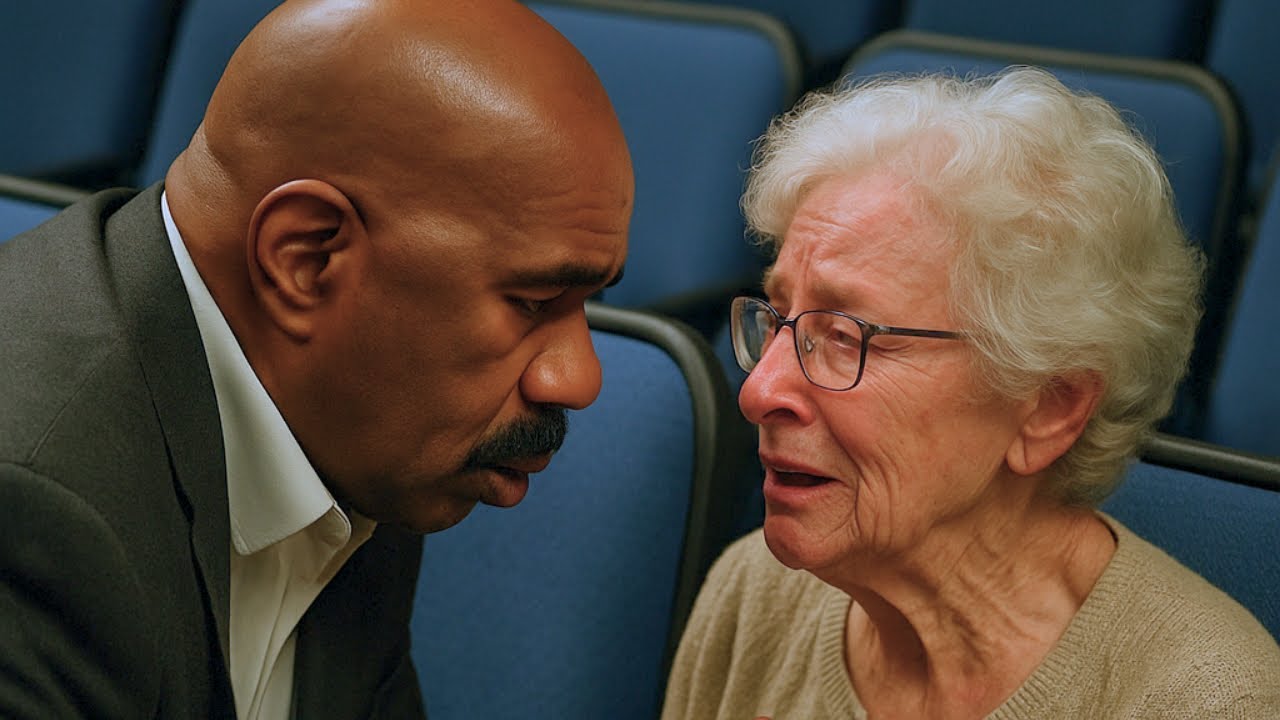
Instead, he quietly walked back across the stage, down the stage steps, and up the aisle toward where the woman sat. The walk took about 15 seconds. During those 15 seconds, Steve’s entire demeanor transformed. The television host disappeared. The celebrity disappeared. What remained was just a concerned human being approaching another human being who was clearly in distress.
“Ma’am.” Steve’s voice was soft, gentle. The microphone had been turned off, but camera 3’s audio, still running, picked up his words. “Are you all right?” The woman looked up, startled. Her face was wet with tears. When she recognized Steve Harvey standing in the aisle beside her, she looked mortified.
“Oh my god, I’m so sorry,” she said, wiping her face frantically. “I’m so sorry. I don’t know why I’m still here. I should go. I’m so sorry.” She started gathering her purse, clearly embarrassed to be seen like this, especially by Steve Harvey. “Hey, hey,” Steve said, sitting down in the seat next to her.
You don’t need to apologize and you don’t need to leave until you’re ready. What’s going on? Why are you crying? The woman, her name was Dorothy Kellerman, though Steve didn’t know that yet, looked at him with surprise. She seemed unable to believe that Steve Harvey was sitting next to her asking her what was wrong. I just Dorothy’s voice broke. I just needed this today.
I needed to laugh. I needed to feel joy. In watching the show, being here, it was the first time in months that I felt anything except sadness. Steve’s expression softened even more. He leaned in slightly, giving her his complete attention. Why months? What happened? Dorothy took a shaky breath. My husband died.
4 months ago, cancer. We’d been married for 43 years. We watched your show every night during his treatment. It was the one thing that could still make him laugh even when he was in pain. He loved you. He loved your show. Steve closed his eyes for a moment. When he opened them, they were wet.
I’m so sorry, he said quietly. 43 years. That’s a beautiful life together. It was, Dorothy said, crying harder now. It really was. And I know I should be grateful for the time we had. Everyone tells me that. But I miss him so much. The house is so quiet. Everything reminds me of him. I got these tickets 3 months ago, thinking maybe coming here would help, that maybe if I came to the place that made him laugh, I’d feel close to him again.
And did you? Steve asked. Did you feel close to him? Dorothy nodded. I did. The whole show I kept thinking about how he would have loved it, how he would have been laughing at the answers, how he would have squeezed my hand during the exciting parts. And then it ended and everyone was leaving and I realized I had to go back to that quiet house, back to being alone and I just I couldn’t make myself stand up.
Steve sat with that for a moment. The studio was almost completely empty now. A few crew members were still working in the far corners, but nobody was paying attention to the conversation happening in row three. Dorothy, Steve said he’d asked her name during her story. Can I tell you something? She nodded, wiping her eyes.
Grief is love with nowhere to go. Steve said, “When you lose someone you love that much, all that love you have for them doesn’t disappear. It’s still there. It’s still real. And it hurts because you can’t give it to them anymore. But that doesn’t mean the love was wasted. That doesn’t mean your 43 years weren’t worth every second of this pain you’re feeling now.
” Dorothy’s tears came harder, but she was listening. and your husband,” Steve continued. He’s not in that quiet house. He’s in your heart. He’s in your memories. He’s in the fact that you came here today because you knew it would make you think of him. That’s not absence. That’s presence.
That’s love that transcends death. Steve reached over and took Dorothy’s hand. I know it hurts. I know the house is quiet. I know everything feels different. But you’re still here. You’re still living. And part of living is learning to carry the people we’ve lost with us while we keep moving forward. Dorothy squeezed his hand. How do you do that? How do you carry them and move forward at the same time? Steve thought for a moment. You honor them.
You live in a way that would make them proud. You find moments of joy, like coming here today, and you let yourself have them without guilt. And you remember that love doesn’t end just because life does. They sat together in silence for a minute. The crew had finished their work and were starting to leave.
Marcus Chen, the camera operator, came back to collect camera 3 and realized with shock that it had been recording the entire time. He started to turn it off, then stopped, watching what was unfolding on his small monitor. “Can I pray with you?” Steve asked Dorothy. She nodded, crying again, but in a different way now, not from despair, but from gratitude.
Right there in row three of the Family Feud studio, Steve Harvey held Dorothy Kellerman’s hand and prayed. He prayed for her healing. He prayed for her strength. He prayed for her to feel her husband’s love surrounding her. He prayed for her house to not feel so empty. He prayed for joy to find its way back into her life.
When he finished, Dorothy was crying but smiling. “Thank you,” she whispered. “Thank you so much. You have no idea what this means to me. I think I do, Steve said gently. We’ve all lost people we love. We’ve all felt that emptiness. You’re not alone in this, even when your house is quiet. Steve helped Dorothy stand.
He walked her out of the studio, his arm around her shoulders. He walked her all the way to the parking lot. He made sure she was okay to drive. He gave her his personal assistant’s phone number and told her to call if she ever needed anything. And Dorothy, Steve said before she got in her car, “Your husband was right to love this show because he knew what really matters.
Connection, laughter, family, and love. You keep watching. And every time you do, know that you’re not just watching a game show. You’re keeping a promise to someone who loved you for 43 years.” Dorothy drove away, her face still teared, but peaceful in a way she hadn’t felt in months. Steve stood in the parking lot for a moment collecting himself.
Then he walked back inside, went to his dressing room, and went home to his family. Camera 3’s footage sat on a hard drive for 3 days before anyone reviewed it. Marcus Chen had tagged it as accidental recording B-roll and didn’t think much of it. But when the editing team reviewed all footage from that day’s shoot, someone noticed the timestamp and decided to watch.
What they saw left the entire production team in tears. The raw, unscripted, completely genuine moment of Steve Harvey comforting a grieving widow. The prayer, the walking her to her car, all of it captured by the forgotten camera. The producers debated what to do with the footage. It felt private, almost sacred. This wasn’t meant to be seen.
This was Steve being human, not Steve being a performer. They called Steve to ask his permission before doing anything with it. Steve listened to the situation and was quiet for a long moment. “Did Dorothy sign a release?” he asked. “Everyone who enters the studio signs general releases,” the producer said.
“But we’re not comfortable using this without explicit permission from her. We’re trying to track her down. Find her,” Steve said. “Ask her if she’s comfortable with it being shared. If she is, you can use it, but only if she’s okay with it. This is her story, not mine. It took two days to find Dorothy Kellerman’s contact information.
When producers called her and explained about the footage, Dorothy was silent for a long moment. Then she said something that surprised them. “Share it,” Dorothy said. “Please share it. Because if my story can help even one person who’s grieving, if Steve’s kindness can remind even one person that compassionate people still exist in this world, then something good comes from my pain.
My husband would have wanted that. The footage aired as a special segment during a regular episode 3 weeks later. The network warned viewers it was different from the usual content, more serious, more emotional, but meaningful. The response was overwhelming. Over 6 million people watched the segment online within 48 hours.
It was shared over 15 million times across social media. Comments poured in from people who’d lost loved ones, people who were grieving, people who felt alone, all saying the same thing. This reminded them that they weren’t alone. But the most powerful responses came from people who said the segment changed how they saw Steve Harvey.
I thought he was just a funny game show host. One comment read, “I had no idea he was this kind of human being. This is who he is when he thinks nobody’s watching.” That’s the measure of a person Dorothy Kellerman appeared on the show 2 months later as a special guest. She looked different, healthier, more peaceful.
She told Steve that after their conversation, she’d joined a grief support group. She’d started volunteering at a hospice center. She’d begun rebuilding her life while honoring her husband’s memory. “You told me that love doesn’t end when life does,” Dorothy said to Steve on camera. “That gave me permission to keep loving my husband while also learning to live again. You saved me that day.
You literally saved my life.” Steve hugged her while audience members cried. “You saved yourself,” he told her. “You had the courage to come back to life. I just reminded you that you could.” The forgotten camera footage became one of the most important pieces of content Family Feud ever produced. Not because it was entertaining, but because it was real.
It showed Steve Harvey, as he truly was, not performing compassion for cameras, but living it when he thought nobody was watching. Marcus Chen, the camera operator who forgot to turn off his equipment, was initially worried he’d be reprimanded. Instead, he was thanked. His accidental recording had captured something that couldn’t have been staged or scripted.
Authentic human goodness. Today, that footage is used in training for television production staff as an example of why cameras should sometimes keep rolling. Because the most meaningful moments often happen in the spaces between performance when people forget they’re being watched and simply act from their hearts.
The story of Steve Harvey and Dorothy Kellerman reminds us that character is what you do when you think nobody’s looking. That the measure of a person isn’t in their public moments, but in their private acts of kindness. And that sometimes the most important television isn’t the show itself.
But what happens when someone thinks the show is over? If this story of unexpected compassion moved you, make sure to subscribe and hit that like button. Share this video with someone who needs to be reminded that genuine kindness still exists in this world. Have you ever witnessed someone being kind when they thought nobody was watching? Tell us your story in the comments below.
And don’t forget to ring that notification bell for more incredible true stories about the moments that show us who people really