Steve Harvey was laughing at everything. 9-year-old Jake said until Jake told a joke about chemotherapy. The audience went quiet. Was it okay to laugh? Then Jake said, “It’s okay. You can laugh.” I did. That’s how I got through it. And suddenly, everyone understood. This wasn’t dark humor. This was survival.
It was August 22nd, 2023 at the Little Big Shot Studio in Los Angeles, California. The afternoon taping was in full swing with Steve Harvey moving through his lineup of talented children with his characteristic warmth and energy. The studio audience of 200 people was having a great time, ready to be entertained by whatever young performer came next.
But what none of them knew was that the next performer had spent more time in hospitals than classrooms, that he’d been given 6 months to live when he was 7 years old, and that he discovered the healing power of laughter while fighting for his life in an oncology ward. Jake Anderson was 9 years old.
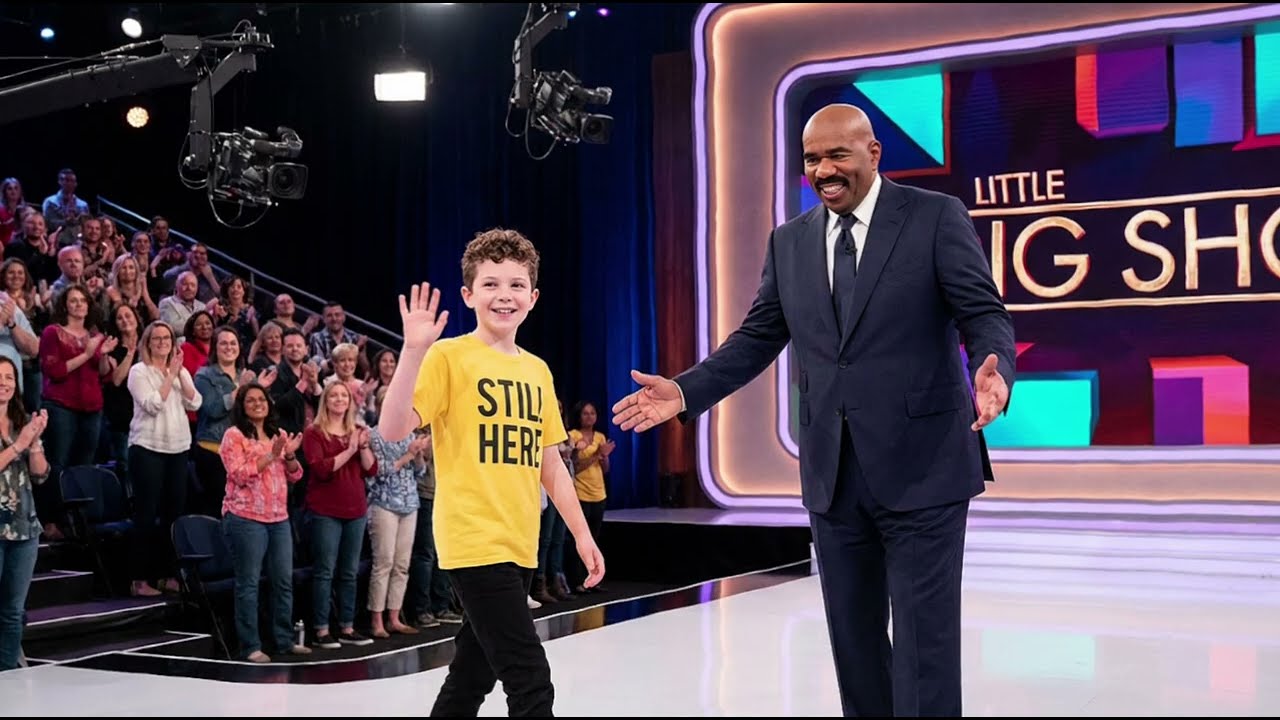
He was small for his age. A side effect of the treatments that had ravaged his body, but ultimately saved his life. His hair had grown back curly after chemotherapy, a common occurrence that he joked made him look like a discount poodle. He wore a bright yellow t-shirt with the words still here printed on it, a shirt he designed himself.
His parents, Michelle and David Anderson, sat in the front row. Michelle’s hands were shaking slightly. She’d watched her son fight death for 2 years. Now she was watching him walk onto a stage to make people laugh about it. She didn’t know whether to be terrified or incredibly proud. She settled on both. Jake’s cancer journey had begun on his seventh birthday.
What should have been a celebration turned into a nightmare when a routine blood test revealed acute lymphoblastic leukemia. Within 48 hours, Jake was in the pediatric oncology unit at Cleveland Clinic, beginning a fight that would define the next two years of his life. The statistics weren’t good. Jake’s particular type of leukemia was aggressive.
Doctors told Michelle and David to prepare for the worst while hoping for the best. They gave Jake 6 months, maybe a year, if treatment went well. Jake didn’t understand statistics. He understood that he was sick, that the medicine made him feel terrible, and that he had to stay in a hospital room instead of playing with his friends.
He understood that his parents cried when they thought he was asleep. He understood that something very bad was happening to him. The first month was brutal. Chemotherapy ravaged Jake’s small body. He vomited constantly. His hair fell out in clumps. He was too weak to walk to the bathroom. There were days when Michelle would sit by his bed watching monitors beep, wondering if her son would see another sunrise.
But something unexpected happened in that hospital room. Jake discovered comedy. It started with a nurse named Patricia. She came to draw blood one morning when Jake was feeling particularly low. He was scared, tired, and angry at a world that had put him in this bed. “I hate needles,” Jake mumbled. Patricia, instead of offering empty comfort, made a face. Me, too.
That’s why I became a nurse, so I could stab other people instead of getting stabbed myself. Jake laughed. It was the first time he’d laughed in weeks. And something clicked in his brain. Laughter made the needle hurt less. Laughter made the room seem brighter. Laughter made him feel, for just a moment, like a normal kid. From that day on, Jake started collecting jokes.
He watched comedy specials on the hospital TV during his treatments. He asked visitors to tell him funny stories. He started making up his own jokes, terrible ones at first, then gradually better ones. “Why did the cancer cell go to school?” he’d ask his nurses. “Because it wanted to divide and multiply.” The joke was dark, but the nurses laughed anyway, delighted to see their young patient finding light in the darkness.
Within a few months, Jake had become the unofficial comedian of the pediatric oncology ward. He’d wheel his IV pole to other kids’ rooms, and perform many stand-up routines. He’d tell jokes to children who were sicker than him, to kids who were losing their battles, to families who desperately needed a reason to smile. “Comedy is my medicine,” Jake told his mom one night.
“Not the real medicine. That one makes me puke, but the other kind of medicine, the kind that makes my brain feel better.” Michelle cried that night, not from sadness, but from amazement. Her seven-year-old son, fighting for his life, had found a purpose. The treatment was long and brutal. Jake relapsed twice, requiring additional rounds of chemotherapy and eventually a bone marrow transplant.
There were moments when the family thought they would lose him. But Jake kept laughing. He kept telling jokes. He kept finding ways to make the darkness a little lighter. Two years after his diagnosis, Jake was declared cancer-free. The cancer that was supposed to kill him in 6 months was gone. Against all odds, against all statistics, Jake Anderson had survived.
When he was finally discharged, the hospital staff lined the hallways to cheer for him. “Jake ever, the comedian, had prepared a speech. “I want to thank everyone for not killing me,” he said into an imaginary microphone. “The hospital food tried its best, but I survived.” The staff laughed through their tears.
They’d never had a patient quite like Jake. Now, seven months after being declared cancer-free, Jake stood in the wings of Little Big Shots. His mother had submitted an audition video showing Jake performing comedy at a local talent show. The producers had called within days. Steve Harvey walked to center stage. All right, everybody.
Our next guest is 9 years old. He’s from Cleveland, Ohio, and he’s here to make us laugh. Please welcome Jake Anderson. Jake walked onto the stage with a confidence that seemed too big for his small body. He waved to the audience, adjusted the microphone stand that was set too high for him, and grinned at Steve.
“Hey, Jake,” Steve said, kneeling down. “I hear you’re a comedian.” “That’s what my mom calls me when she’s being nice.” Jake said, “When she’s mad, she has other words.” The audience laughed. Steve laughed. Jake was already in his element. “So, you’re going to tell us some jokes today?” Steve asked, “Yes, sir. But first, I need to warn everyone.” Jake paused dramatically.
I’m not responsible for any injuries caused by laughing too hard. Sign this waiver. He pretended to hand Steve an invisible paper. More laughter. Steve was already impressed. This kid had natural timing. “All right, Jake. The stage is yours.” Steve said, stepping aside. Jake took center stage.
He looked out at the audience, took a breath, and began. So, I’m 9 years old. I like video games, pizza, and not dying. That last one is a new hobby. A few tentative laughs. The audience wasn’t sure where this was going. See, 2 years ago, I had cancer, leukemia. The doctors told my parents I had 6 months to live. Jake paused.
That was 2 years ago. I’m still here. Turns out doctors are great at medicine, but terrible at math. That’s when it happened. The audience laughed, but it was uncertain laughter. They looked at each other, at Steve, at this small boy on stage. Were they supposed to laugh at cancer jokes? Jake sensed the hesitation. It’s okay. You can laugh.
I did. That’s how I got through it. Something shifted in the room. Permission had been granted. The audience relaxed. Jake continued, “Chemotherapy is wild. They pump poison into you to save you. That’s like setting your house on fire to get rid of a spider.” And just like the spider, the cancer was like, “Okay, fine.
I’ll leave.” But you didn’t have to be so dramatic about it. Real laughter now. Steve Harvey was watching from the side of the stage. His expression a mixture of amazement and emotion. I lost all my hair during treatment. I was completely bald. Kids at school called me Qball. With jokes on them, my hair grew back curly. Now I look like a baby sheep.
So I went from Qball to baba. Not sure if that’s an upgrade. The audience was fully on board now. Laughing at every punchline. The worst part of cancer wasn’t the treatment. It was the hospital food. I’m convinced the cafeteria was trying to kill me faster than the cancer. I told my doctor, “I’ve fought leukemia for 2 years.
I think I deserve a pizza.” He said, “That’s not how nutrition works.” I said, “Fine, then I want a nutritious pizza.” He didn’t think that was funny. I did. Jake was on a roll. His timing was impeccable. His delivery natural. His material surprisingly sophisticated for a 9-year-old. The hospital I was in had a thing called a wish list for sick kids.
You know, like make a wish, but smaller. They asked me what I wanted. I said, “I want to be a stand-up comedian.” The nurse said, “That’s not usually what kids ask for.” I said, “The usual kids aren’t as funny as me.” She didn’t argue. Steve Harvey was wiping his eyes now, not entirely from laughter. People always say laughter is the best medicine. That’s not true.
Chemotherapy is the best medicine, but laughter is a really good side dish. Like chemo is the steak and laughter is the mashed potatoes. You need both or dinner is really depressing. Jake paused, then delivered his closer. I spent 400 days in the hospital. I missed 2 years of school. I lost my hair, my energy, and about 20 lb I really couldn’t afford to lose.
He gestured at his small frame. But I never lost my sense of humor. Because here’s what I learned. Cancer can take a lot from you. It can take your hair. It can take your strength. It can take your friends, your time, your childhood. But it can’t take your jokes. Those are yours. And as long as you can laugh, you’re still alive.
He looked directly at the audience. I’m Jake Anderson. I’m 9 years old. I beat cancer and I’m just getting started. The audience erupted. Not just applause, a standing ovation. People were on their feet cheering, crying, overwhelmed by what they just witnessed. This wasn’t just a talented kid telling jokes.
This was a survivor turning his trauma into triumph. Steve Harvey walked back onto the stage. He wasn’t hiding his tears anymore. Jake, Steve said, his voice cracking. In all my years of doing this, I have never, I mean, never seen anything like what you just did. Thanks, Mr. Harvey. I’ve been practicing mostly on nurses. They’re a tough crowd.
Steve laughed through his tears. How did you learn to do this? How did you find comedy in the middle of cancer treatment? Jake’s demeanor shifted slightly. Still confident, but more sincere. When you’re really sick, everyone around you is sad. Your parents are sad. The doctors are worried. The nurses try to smile, but you can tell they’re scared, too.
And all that sadness is heavy. It’s really heavy. Comedy made it lighter. When I made a joke and someone laughed, even for a second, the heaviness went away. I thought, “If I can make myself feel better with jokes, maybe I can make other people feel better, too.” Steve brought Michelle and David onto the stage. Michelle was sobbing.
David had his arm around her, trying to hold it together. “Mrs. Anderson,” Steve said. “Your son just taught this entire audience something about courage and resilience. How do you feel?” Michelle could barely speak. For two years, I watched my baby fight for his life. There were days, I didn’t think he’d make it.
But even on the worst days, he’d crack a joke. He’d make his nurses laugh. He’d go to other kids’ rooms to cheer them up. I don’t know where he got this gift, but I’m so grateful for it. Laughter saved him, and now he’s sharing it with the world. Steve addressed the audience. Ladies and gentlemen, I want you to understand something.
This boy was given 6 months to live at age 7. He spent 400 days in hospitals. He went through things that most adults couldn’t handle. And his response was to become a comedian. To take the worst experience of his life and turn it into something that brings joy to others. That’s not just talent. That’s grace. Steve announced that his foundation would be partnering with pediatric cancer organizations to create comedy workshops for children undergoing treatment, a program called Laughter Rounds inspired by Jake. He also connected Jake with
professional comedians who wanted to mentor him. The episode aired 6 weeks later and became one of the most watched Little Big Shots episodes in history with over 72 million views across all platforms. But the impact went far beyond entertainment. Hospitals across the country started implementing comedy therapy programs for pediatric patients.
Jake’s clips were shared in oncology wards worldwide, showing sick children that humor was a legitimate way to cope. Families dealing with childhood cancer wrote to Jake by the thousands telling him that his jokes had helped them through their darkest moments. Three years after his Little Big Shots appearance, Jake Anderson, now 12, released his first comedy special filmed at the Cleveland Clinic where he’d been treated.
The audience was made up of cancer survivors, patients currently in treatment, their families, and the medical staff who’d saved his life. His opening line at that special brought down the house. Welcome to my comedy show at Cleveland Clinic. Fair warning, my jokes are a lot like chemotherapy. They might hurt a little, but they could save your life.
Jake went on to become one of the youngest professional comedians in the country. He performs regularly at charity events for pediatric cancer research. He visits hospitals to do standup for sick children, and he never forgets where his comedy came from. Cancer gave me two things, Jake said in an interview years later.
A really scary two years and a really funny rest of my life. I think that’s a fair trade. The story of Jake Anderson reminds us that humor is not a denial of pain, but a victory over it. That children often handle adversity with more grace than adults. That the darkest experiences can produce the brightest lights. And that sometimes the bravest thing you can do is laugh.
If this story moved you, make sure to subscribe and hit that like button. Share this video with someone who needs to be reminded that laughter is a form of courage. Do you know someone who’s used humor to survive something difficult? Tell their story in the comments below. And don’t forget to ring that notification bell for more incredible stories about children who teach us what it really means to be brave.