Steve Harvey was in the middle of his opening monologue when a homeless man walked onto the stage from the wings. Security rushed forward. The audience gasped, but then Steve looked at the man’s face. And everything stopped because standing there in torn clothes and a weathered face was someone Steve Harvey hadn’t seen in 32 years.
Someone he thought he’d never find again. It was March 23rd, 2021 at the Steve Harvey Show Studios in Los Angeles. The afternoon taping was going smoothly. Steve was doing what he does best, making the audience laugh with stories about his family, his observations about life, and that signature Steve Harvey energy that had made him a household name.
The studio was packed with 200 enthusiastic fans. The cameras were rolling. Everything was perfectly choreographed, perfectly timed, perfectly professional. Steve was in the middle of a story about his wife Marjorie trying to teach him how to use Instagram when something completely unscripted happened from stage left through the entrance that only staff members used.
A man walked onto the stage. He was wearing layers of torn clothing despite the California heat. His face was weathered and deeply lined. His hair was long, gray, and uncomebed. His hands shook slightly as he moved. He walked with the uncertain gate of someone who wasn’t quite sure where he was or what he was doing there. The [snorts] audience noticed him first.
A few people pointed. Some gasped. Others looked confused, wondering if this was part of the show. The production staff reacted immediately. Two security guards moved toward the stage from opposite sides of the studio. A producer in the control room was already calling for commercial break.
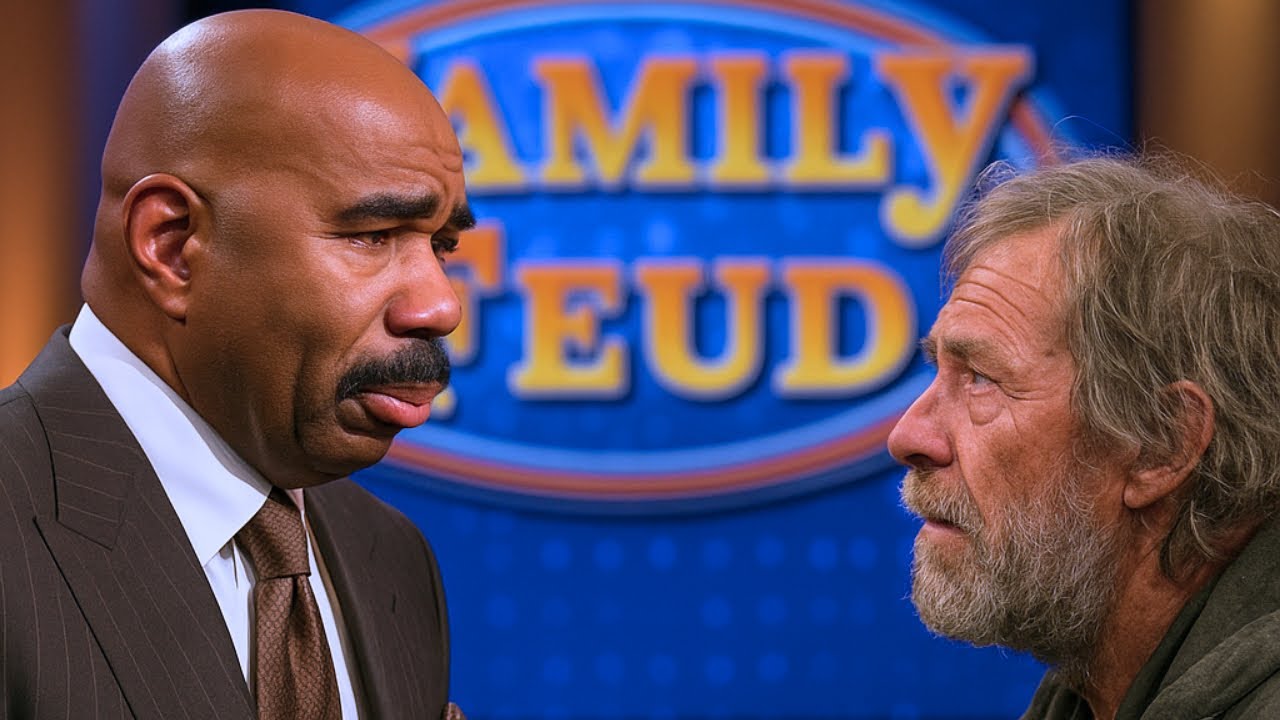
The stage manager was frantically signaling to cut the cameras, but Steve Harvey saw the man before anyone could intervene. Steve stopped talking mid-sentence, his smile faded. He stood completely still, microphone halfway to his mouth, staring at this homeless man who had wandered onto his stage during a live taping. The man looked around, confused and disoriented.
The bright stage lights seemed to hurt his eyes. The sudden attention from 200 people appeared to frighten him. He took a step backward as if he might run. “Wait,” Steve said, his voice cutting through the chaos. “Don’t touch him.” The security guards froze. The producer in the control room held off on the commercial break.
The stage manager stopped signaling. Everyone waited to see what Steve Harvey would do. Steve walked slowly toward the homeless man, his eyes never leaving the stranger’s face. The audience sat in confused silence. This wasn’t part of any script. This wasn’t a planned segment. Something real was happening. Steve stopped about 5 ft away from the man.
He tilted his head, studying the weathered face, looking for something. The man looked back at Steve with cloudy eyes that showed confusion, but also a flicker of something else. Maybe recognition, maybe just hope. “Do I know you?” Steve asked quietly, but his microphone picked up every word. The homeless man didn’t answer. He just stood there swaying slightly, looking at Steve Harvey like he was trying to remember something important, but couldn’t quite grasp it.
Steve took another step closer. Cleveland, he said, and his voice cracked on the word. Cleveland, Ohio, 1987. The Hilarities Comedy Club. The man’s eyes widened slightly. Something shifted in his expression. There was a diner next door, Steve continued, his voice shaking now, called Mabels. It was 2:00 in the morning.
I was sitting alone in my car in the parking lot because I was living in that car. And you, Steve’s voice broke. You knocked on my window. The homeless man’s mouth opened. His hands stopped shaking. Tears began forming in his eyes. “You bought me a hot meal,” Steve said, and now he was crying openly. “Meatloaf, mashed potatoes, and apple pie.
You sat with me for an hour and when you left, you gave me $20 and you said Steve had to stop and collect himself. You said, “Don’t quit. I see something special in you.” The man’s legs buckled slightly. Steve reached out and caught his arm, steadying him. “Harold?” Steve whispered. “Is that you? Are you Harold?” The homeless man nodded, tears streaming down his weathered face.
“You remember me?” he said, his voice rough from years of hard living. You remember me? Steve Harvey wrapped his arms around Harold and held him while both men cried. The audience sat in stunned silence. The cameras kept rolling, capturing every second of this impossible reunion. What nobody in that studio knew, what even Steve’s own staff didn’t fully understand, was the significance of this moment.
Because Harold wasn’t just a kind stranger who’d helped Steve Harvey once. Harold was the reason Steve Harvey had kept going during the darkest period of his life. In 1987, Steve Harvey was 30 years old and failing at his dream. He’d quit his job to pursue comedy full-time, a decision that had cost him his marriage,his house, and eventually his ability to afford any housing at all.
For three years, he lived in a 1976 Ford Tempo, sleeping in the back seat, showering in gas station bathrooms, and performing at any comedy club that would book him for $50 a night. Cleveland had been particularly brutal. Steve had driven 8 hours from Detroit for a gig that paid $75, but when he got there, the club owner said business was slow and offered him $30 instead.
$30 for an 8hour drive and a performance. Steve took it because he had no choice. He performed for 18 people in a dingy basement comedy club, made them laugh despite his despair, and walked back to his car with $30 in his pocket. It was January. It was Ohio. It was freezing. Steve sat in his car in the parking lot of Mabel’s Diner, watching people inside eating warm food.
He had $30 to his name. He needed gas to get back to Detroit. He needed to save some money for his next meal, whenever that might be. He was hungry, exhausted, and beginning to think his ex-wife had been right when she said he was wasting his life chasing an impossible dream. That’s when Harold knocked on his window.
Harold was just a regular guy, a factory worker on his way home from a late shift. But something about the young man sitting alone in a cold car in a diner parking lot at 2:00 in the morning made Harold stop. Maybe it was divine intervention. Maybe it was just human compassion. But Harold tapped on the window and asked if Steve was okay. Steve lied and said he was fine.
Harold didn’t believe him. He asked Steve to come inside and have coffee. Steve said he couldn’t afford it. Harold said it would be his treat. They sat in a booth at Mabel’s Diner for over an hour. Steve told Harold everything about his dream, his failures, his living situation, his doubts. Harold listened without judgment. He ordered Steve a full meal.
Meatloaf, mashed potatoes, green beans, and a slice of apple pie. He made sure Steve ate every bite. When they finished, Harold pulled $20 from his wallet, probably money he couldn’t afford to give away on a factory worker’s salary, and pressed it into Steve’s hand. And then he said the words that would echo in Steve’s mind for the next 32 years. Don’t quit.
I see something special in you. You’re going to make it. And when you do, you’re going to help a lot of people, but you have to keep going. Promise me you won’t quit. Steve promised. He didn’t really believe he’d make it, but he promised anyway because this stranger had shown him more kindness than anyone had in months, and he felt obligated to at least try.
Harold paid the check, shook Steve’s hand, and walked out of Mabel’s diner. Steve never saw him again. He didn’t get Harold’s last name, didn’t get a phone number. Harold was just a kind stranger who appeared at exactly the right moment and then disappeared into the night. But Steve kept his promise. He didn’t quit.
He kept performing, kept failing, kept trying. And slowly, gradually, things started to turn around. He got better gigs. He got noticed. He got his big break. And suddenly, Steve Harvey wasn’t a homeless comedian sleeping in his car. He was a successful comic, then a TV host, then a household name. As the years passed and Steve became successful, he never forgot Harold.
He told the story in interviews. He mentioned Harold in his book. He hired private investigators to try to find Harold in Cleveland, but it was nearly impossible. Harold was a common first name. Steve didn’t know his last name, and 32 years is a long time. People move, people change, sometimes people disappear.
Steve had given up hope of ever thanking Harold properly. He’d made peace with the fact that Harold would remain an anonymous angel in his life story. Someone whose kindness had saved him, but whose identity would remain forever unknown. Until March 23rd, 2021, when Harold walked onto his stage. Later, after the show, after the camera stopped rolling, the full story emerged.
Harold’s life had taken a tragic turn. The factory where he worked had closed in 1993. Harold lost his job, his house, his family. He’d struggled with depression and alcohol. He’d ended up on the streets of Los Angeles, thousands of miles from Cleveland, homeless and forgotten. Harold didn’t even know he was walking onto Steve Harvey’s stage.
He’d wandered into the studio building looking for a bathroom. The security at the front entrance was busy with arriving audience members. Harold slipped through looking for help. Disoriented and confused, he’d wandered through corridors until he found a bright doorway and walked through it directly onto the stage during a live taping.
He didn’t recognize Steve at first. 32 years and massive fame had changed Steve’s appearance. But when Steve said Cleveland and Mabel’s Diner, the memories came flooding back. Harold remembered the young comedian in the cold car. He remembered buying him dinner. He remembered telling him not to quit.
But Harold had no idea that theyoung man he’d helped had become Steve Harvey. Standing on that stage, Steve Harvey made a decision. Right there in front of 200 audience members and thousands of television viewers, Steve made a promise. Harold, Steve said, his arm still around the older man’s shoulders. You saved my life that night. You gave me hope when I had none.
You made me promise not to quit, and I kept that promise. Now, I’m going to make you a promise. The audience was dead silent, hanging on every word. You’re not going back to the streets. Not tonight. Not ever. You’re going to stay with me until we figure this out properly. But here’s what’s going to happen right now. Steve turned to his producers.
Call the Beverly Hilton. Get Harold their best suite. He’s staying there for the next month on my account. He looked back at Harold. And that’s just the beginning. Over the next hour, while the scheduled show was abandoned, Steve Harvey orchestrated Harold’s rescue. He called his personal doctor to arrange a full medical evaluation.
He contacted a mental health specialist who worked with homeless veterans and crisis intervention. He called his accountant and established a trust fund that would provide Harold with a steady income for the rest of his life. But more than the practical help, Steve gave Harold something more valuable. Dignity and recognition. He brought Harold back on stage after he’d been cleaned up by the wardrobe department and given fresh clothes.
Steve told Harold’s story to the audience. He made sure everyone understood that the successful man they saw today existed because of the kind man standing beside him. This man, Steve told the audience, tears streaming down his face. This man didn’t help me because I was special. He helped me because I was human and I needed help.
He didn’t know I would become Steve Harvey. He just saw a person in need and did something about it. That’s real compassion. That’s real humanity. The audience gave Harold a standing ovation that lasted five full minutes. People were crying, clapping, and cheering for this weathered homeless man who probably hadn’t heard applause in decades.
The episode never aired in its original form. Instead, Steve’s team created a special episode dedicated entirely to Harold’s story. It became one of the most watched episodes in the show’s history. Viewed over 60 million times across various platforms. But the real story is what happened after the cameras stopped rolling.
Steve kept every promise he made. Harold stayed at the Beverly Hilton for a month, then moved into a small apartment that Steve helped him lease. Harold received treatment for his health issues and counseling for his trauma. Slowly, carefully, Harold began rebuilding his life. Steve visited Harold regularly. They became genuine friends.
Steve made sure Harold knew he wasn’t a charity case. He was family. Steve involved Harold in his foundation work, helping other homeless individuals. Harold’s story of both giving and receiving kindness became an inspiration. Eight months after walking onto Steve’s stage, Harold stood before a Los Angeles city council meeting and shared his story.
He advocated for better mental health services and support systems for homeless individuals. His testimony, backed by Steve Harvey’s presence and support, helped pass new legislation for homeless support services in Los Angeles. I was invisible, Harold said in that meeting, his voice steady now, his eyes clear. For years, I was invisible.
People looked through me like I was a ghost. But Steve Harvey saw me. He recognized me after 32 years. And that changed everything. Not just for me, but for everyone like me who feels invisible. Harold lived for three more years after his reunion with Steve. He spent those years housed, healthy, and purposeful.
He volunteered at homeless shelters. He shared his story at schools and community centers. He became an advocate for compassion and kindness. When Harold passed away in 2024 at the age of 79, Steve Harvey delivered the eulogy. He talked about that freezing night in Cleveland. He talked about meatloaf and apple pie and $20 that meant more than any amount of money he’d ever earned.
He talked about how one act of kindness can ripple forward through time and change the world. Harold didn’t just help me that night, Steve said at the funeral. He taught me what matters. Success, fame, money. None of it means anything if you don’t use it to help others. Harold showed me that when I had nothing.
And when Harold needed help, I got to return that kindness. That’s not luck. That’s not coincidence. That’s the universe showing us that love and compassion always come back around. Today, the Steve Harvey Foundation runs a program called Harold’s Promise, providing support for homeless individuals who are trying to rebuild their lives.
The program has helped over 5,000 people find housing, employment, and hope. And in Steve Harvey’s office, hanging prominently on the wall is aphotograph from that March day in 2021. It shows Steve embracing Harold on stage, both men crying, both men saved by each other’s kindness 32 years apart. The story of Steve and Harold reminds us that we never know when a small act of kindness might change someone’s life.
Harold spent $20 and one hour on a stranger and inadvertently helped create one of entertainment’s biggest stars. Steve Harvey recognized a homeless man who wandered onto his stage and gave back a kindness that had been waiting 32 years to be repaid. If this incredible story of kindness coming full circle moved you, make sure to subscribe and hit that like button.
Share this video with someone who needs to be reminded that no act of kindness is ever wasted. Have you ever had someone help you at exactly the right moment? Or have you helped someone not knowing the impact it would have? Share your stories in the comments below. And don’t forget to hit that notification bell for more amazing true stories about compassion, redemption, and the power of never forgetting where you came